




How to Improve Communication in a Relationship (Based on New Survey Data)

Reviewed By
Kristen Failla, LMFT
 Review Board Member
|
By
LMFT
Review Board MemberKristen is a Licensed Marriage and Family Therapist who provides mental health care for individuals, couples and families. She is particularly passionate about working with... Read More
Marriage.com Editorial Team

The Marriage.com Editorial Team is a group of experienced relationship writers, experts, and mental health professionals. We provide practical and research-backed advice on relationships. Our content is thoroughly reviewed by experts to ensure that we offer high-quality and reliable relationship advice.
Learn about Our Editorial Process
Updated: 20 Aug, 2026
Heal & Grow Daily for a Happier Relationship
Subscribe FREETable of Contents
View more
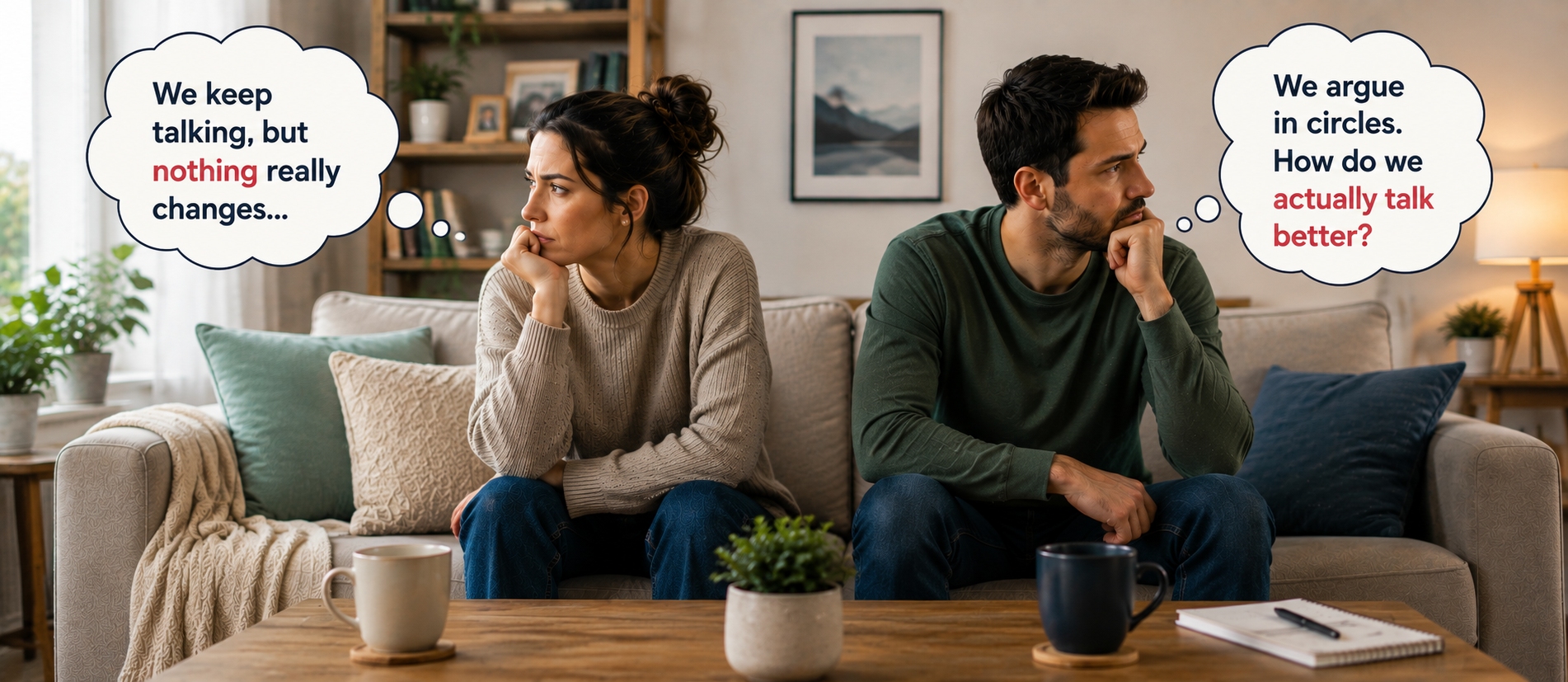
If you are searching for how to improve communication in a relationship because a conversation with your partner went nowhere again, you are not alone. Most advice tells couples what they should do.
According to Kristen Failla, LMFT, “All couples can benefit from improved communication. As individuals grow, change, and evolve, they are in need of their relationships to do the same, and this can be done by strengthening all types of communication.”
We asked 2,300+ adults in our survey on couples avoiding difficult conversations what they actually tried. Then we looked at which of those approaches has real research behind it.
The honest answer: most couples start informally, a smaller group gets structured, and nearly 3 in 10 try nothing at all. None of that means you are behind. It means you are in good company, and there is a clear next step.
What Do Couples Actually Try to Improve Communication?
When our survey asked what couples had done to improve how they talk to each other, the answers leaned informal more often than structured.

1. Advice from friends or family (29.4%). The most common first move. Low cost and easy to access, but limited by the advice giver’s own relationship experience.
2. Self-help resources like books or online content (27.7%). Women reported using these somewhat more than men (29%). Accessible and private, though rarely built around a specific couple’s patterns.
3. Shared communication rules (20.9%). Couples who set explicit agreements, like no interrupting or a cooling-off signal during arguments.
4. Couples therapy (14.5%). The most structured option in the list, guided by a trained professional rather than self-direction.
5. Regular relationship check-ins (9.5%). A scheduled, recurring conversation rather than a one-time fix.
Nearly 30% of respondents said they had tried none of these. Men were more likely to fall into this group (32%, compared to women). Married couples leaned slightly more toward structured approaches, while dating couples reported the highest share of taking no action at all.
Our survey did not measure how well each approach worked or how long couples stuck with it. We want to be upfront about that gap rather than guess.
What we can do is look at relationship research to understand why some approaches tend to hold up better than others.

Which of These Approaches Does Research Actually Support?
The American Psychological Association points out that how a couple fights matters more than how often they fight. Couples who rely on destructive behavior during arguments, such as yelling, personal criticism, or shutting down, are more likely to break up than couples who fight constructively.
Listening to a partner’s point of view and trying to understand their feelings is a healthier way to handle disagreements.
That finding lines up directly with the shared communication rules approach in our survey. A rule like no raised voices or a pause signal is a concrete way to choose constructive conflict over destructive conflict, decided in advance rather than in the middle of an argument.
There is also research on the more structured end of the spectrum.
A meta-analysis published in the Journal of Family Psychology reviewed 97 marriage and relationship education studies. It found that programs with more contact hours produced stronger improvements in couples
Cognitive behavioral work developed through the Beck Institute adds another piece. Dr. Aaron Beck foundational work on couples identified how automatic negative thoughts about a partners intentions escalate ordinary disagreements into bigger conflicts.
Learning to notice and question those thoughts, sometimes called cognitive reframing, is a skill actively taught in couples therapy.
Taken together, this is our own read, not a conclusion from any single study: informal advice and self-help tend to build awareness, shared rules and check-ins tend to build habits, and therapy adds direct, guided practice.
None of these are wrong to try. They speak to different parts of the problem.
Why the Gap Between Trying and Sticking With It Matters
Nearly 30% of couples reporting no action at all is not a story about not caring. It is a story about not knowing where to start, which is a more solvable problem.
Kristen Failla highlights, “One of the most positively impactful benefits of couples therapy is that it provides a safe, supportive yet challenging environment where couples can practice consistency in communication. This helps the interactional skills developed in therapy become sustainable and lead to effective problem solving and conflict resolution.”
One approach failing to fix everything does not mean communication cannot improve. A single self-help book will not resolve a pattern that took years to form. A shared rule you both forget by your third argument is not a failure. It is a sign the rule needs to be simpler.
Our survey cannot tell you which approach works best, but it does show, alongside the difficult conversations couples avoid and how couples handle conflict findings, that most couples are dealing with a recognizable, shared pattern.
If your relationship feels uniquely bad at this, the data suggests otherwise.
A Quick Self-Assessment: Where Are You Starting From?
Before picking a next step, it helps to see where you already stand. Answer honestly rather than aspirationally.
Question If mostly yes If mostly no
Have you tried a structured approach (rules, check-ins, therapy)? Build on what is already working Start with one low-effort habit, like a weekly 10-minute check-in
Do arguments usually end with old issues resurfacing? A check-in habit may help prevent recycling old arguments Look at what is keeping conflicts unresolved before choosing a fix
Does one of you usually shut down during conflict? A shared cooling-off signal may fit well Look at what happens during arguments before choosing a fix
Have you talked to friends or family without much change? You may be ready for a more structured step That is a normal starting point, not a dead end
If either of the middle two answers is “mostly no” for you, two of our other survey articles go deeper: why unresolved conflict resurfaces and what happens during arguments.
How to Start Improving Communication This Week
Pick one approach rather than several at once. Trying to change how you communicate in every area at the same time is one of the fastest ways to abandon the effort within a month.
If you are starting from nothing, a weekly 15-minute check-in is the lowest-effort structured option. Sit down without phones, and each of you answers two questions: what felt good this week, and what felt hard.
Kristen Failla mentions, “Abiding by a specific rule like this also provides an opportunity for increased trust in the relationship.
By respecting one another’s requests (such as no cursing or raised voices within conflict), you are emphasizing your commitment to the relationship and showing your partner that you are capable of change within improving communication.”
If you already talk regularly but conversations go in circles, a shared rule tends to help more than another conversation about the same topic. Agree on one concrete rule, such as no raised voices or a signal that either partner can use to pause and return later.
If your patterns feel bigger than either of you can shift alone, therapy is not a last resort. It is a direct route to the skills the research above points to. You do not need to be in crisis to benefit from working with a professional.
Mistakes Couples Make When Trying to Improve Communication
- Trying to fix everything at once. Picking five new habits in one week is a setup for giving up on all of them. Start with one.
- Bringing up the fix mid-argument. Introducing a new communication rule while you are already upset rarely lands. Set it up during a calm moment instead.
- Treating one hard conversation as proof nothing works. A single setback after trying something new is normal. It is not evidence the approach failed.
- Waiting for a crisis to consider therapy. Many couples wait until things feel unfixable before reaching out, when earlier support is often easier to build on.
- Expecting your partner to read the same book or article you did. Improvement tends to work best as something you build together, not something you hand your partner as advice.
When to Consider Couples Therapy or a Structured Program
If you have tried informal approaches and still feel stuck, that is not a sign of a failing relationship. It may be a sign you would benefit from more structure than a book or a conversation with a friend can offer.
A structured program, like the options available through Marriage.com’s courses, can give you frameworks and exercises without requiring a weekly appointment. For couples who want direct, personalized guidance, working with a licensed therapist through Marriage.com’s therapist directory is a proactive step, not an admission of defeat.
Whichever direction you choose, the shift that matters most is moving from talking about communication to practicing it on purpose. That is the same shift that shows up in our look at why couples avoid hard conversations in the first place.
Frequently Asked Questions
No. Many couples enter therapy to build skills proactively, not because the relationship is failing. Nothing about how couples therapy works requires a relationship to be in trouble first. In our survey, only 14.5% of couples had tried therapy at all, so reaching out proactively still puts you ahead of most respondents. Think of it less as a repair shop for broken relationships and more as a skills class you can take at any point, even when things feel mostly fine. Waiting until a relationship feels unfixable is common, but it is a habit worth questioning rather than a rule to follow. There is no single verified timeline for this, and we would rather say that plainly than give you a number we cannot back up. Cognitive behavioral work developed through the Beck Institute's approach to relationships treats communication change as a gradually built skill rather than a one-time insight. That means a few setbacks along the way are part of the normal process, not a sign to quit. If you are working with a therapist, they can help you tell the difference between a normal adjustment period and an approach that genuinely is not working for your relationship. They can raise awareness and introduce useful language, and 27.7% of couples in our survey had tried them, making it the second most common approach overall. Their limitation is that they are not personalized to your specific pattern as a couple, which is where a shared rule or professional support tends to add more. A book can be a helpful starting point for a conversation with your partner about what you each want to change, even if it does not solve the pattern on its own. Treat a book as a conversation starter rather than a finished plan, and expect to adapt whatever you read to fit how the two of you actually talk. Start with something so small it does not feel like a project, such as suggesting a single ten minute check-in rather than a whole new system. Framing it as an experiment rather than a fix tends to feel less threatening to a hesitant partner, and one good experience often opens the door to trying more. Avoid presenting it as something you researched to fix them specifically. Framing it as something you want to try together, out of curiosity, tends to lower defensiveness. If your partner still resists any change, that pattern itself may be worth bringing to a therapist, even on your own at first. Yes. The American Psychological Association has found that couples who rely on destructive behavior during arguments, such as yelling, personal criticism, or withdrawing from the discussion, are more likely to break up than couples who fight constructively. A shared rule is simply a way to commit to constructive conflict before an argument starts, rather than trying to remember it in the middle of one. In our survey, 20.9% of couples had already set shared rules, more than tried therapy but fewer than tried informal advice or self-help. The key is picking one specific, concrete rule rather than a vague goal like "communicate better." Is couples therapy only for relationships in crisis?
How long does it take to see communication improve?
Can self-help books actually improve how couples talk?
What if my partner is not willing to try anything new?
Does setting communication rules actually make a difference?
Where Your Relationship Can Go From Here
Most couples in our survey are already trying something, and nearly a third are trying nothing yet. Neither of those is a verdict on your relationship. Both are just a starting point.
The couples who see change are not the ones who found a perfect approach on the first try. They are the ones who picked one thing and kept at it past the first setback.
That is available to you starting this week, whether that means a fifteen minute check-in, one shared rule, or a first conversation with a therapist.
Helpful?
Continue exploring this topic

Marriage.com AI: Your Relationship Guide
Talk through what's on your mind.
Automated
YOU COULD START WITH
Share this article on
Marriage.com Editorial Team
Relationship & Marriage Advice
The Marriage.com Editorial Team is a group of experienced relationship writers, experts, and mental health professionals. We provide practical and research-backed advice on relationships. Our content is thoroughly reviewed by experts... Read more to ensure that we offer high-quality and reliable relationship advice. Read less



Recent Articles


Related Quizzes








 We'd love your feedback!
 Thanks for your feedback!