




Difficult Conversations in Relationships: The 4 Topics Couples Avoid Most

Reviewed By
Kristen Failla, LMFT
 Review Board Member
|
By
LMFT
Review Board MemberKristen is a Licensed Marriage and Family Therapist who provides mental health care for individuals, couples and families. She is particularly passionate about working with... Read More
Marriage.com Editorial Team

The Marriage.com Editorial Team is a group of experienced relationship writers, experts, and mental health professionals. We provide practical and research-backed advice on relationships. Our content is thoroughly reviewed by experts to ensure that we offer high-quality and reliable relationship advice.
Learn about Our Editorial Process
Updated: 29 Jul, 2026
Heal & Grow Daily for a Happier Relationship
Subscribe FREETable of Contents
View more
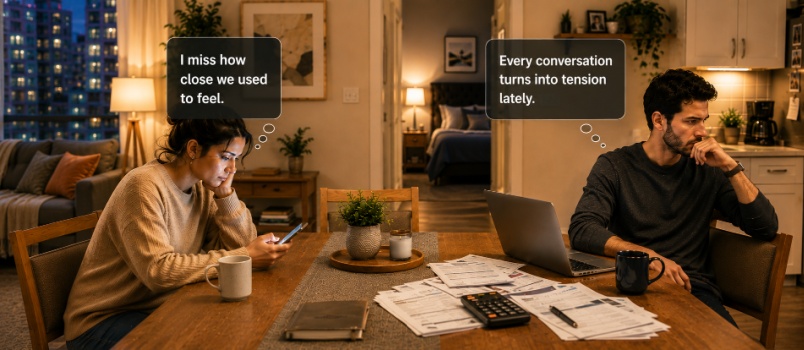
There is a specific kind of silence that lives in long-term relationships. It is the pause before you bring up the credit card statement. The way you change the subject when your partner mentions their ex. The text you start writing about how lonely you have been feeling, then delete.
If any of that sounds familiar, you are in good company. In a Marriage.com survey of more than 2,300 U.S. adults, nearly 70% said they avoid at least one important conversation with their partner. The fear is rarely about the topic itself. It is about what bringing it up might cost.
A difficult conversation in a relationship is any exchange where the stakes feel personal and the outcome feels uncertain, most commonly about emotions, sex, jealousy, or money. Almost 70% of couples avoid at least one of these topics, according to a 2026 Marriage.com survey of 2,300 U.S. adults.
This article walks through the four most-avoided conversations, the data on why couples sidestep them, and what to say when you are ready to stop.
For the full survey methodology and demographic breakdowns, see the original research report.

Quick answer
The four most avoided conversations in relationships are about emotions (about 1 in 3 couples), sex and physical intimacy (33.8%), jealousy or trust (28.7%), and money (25.7%), based on a 2026 Marriage.com survey of 2,300 U.S. adults. Married couples are most likely to avoid money conversations, while those casually dating most often sidestep talk about future plans. Nearly 70% of all couples avoid at least one of these topics, usually out of fear of their partner’s reaction or fear of harming the relationship.
What counts as a difficult conversation in a relationship?
A difficult conversation is any exchange where the stakes feel personal and the outcome feels uncertain. You care about the answer, you care about your partner’s reaction, and you are not sure you can predict either. That uncertainty is what makes the conversation feel hard, not the subject matter on its own.
Difficult conversations tend to share three features. They involve a need or feeling you have been carrying privately. They risk exposing something vulnerable, like jealousy, financial shame, or unmet desire. And they raise the possibility that your partner will respond in a way that confirms your worst fear: that you are too much, or not enough, or that the relationship cannot hold the truth.
Therapists call the pattern of dodging these conversations avoidance communication. It can look like staying calm and pleasant on the surface while a real concern goes unsaid.
Research on demand-withdrawal and mutual avoidance patterns, led by lab of Janice Kiecolt-Glaser at Ohio State University, has linked these communication dynamics to higher inflammation, slower wound healing, and more negative emotion, with the effects strongest in wives. Silence has a body. It does not stay in your head.
What are the most avoided conversations in relationships?
The four most avoided conversations in relationships are about emotions or emotional needs (about 1 in 3 couples), sex and physical intimacy (33.8%), jealousy or trust (28.7%), and money or spending (25.7%), according to a 2026 Marriage.com survey of 2,300 U.S. adults. The percentages below reflect how many respondents named each topic as one they sidestep with their partner.
Each of these topics has a surface version and a deeper version. The surface is what the fight would look like if you had it. The deeper version is what you are actually trying to protect.
| Avoided topic | % of couples | What's underneath it |
|---|---|---|
| Emotions and emotional needs | ~33% | Fear of being seen as too needy, too sensitive, or a burden to your partner. |
| Sex and physical intimacy | 33.80% | Fear of rejection, fear of hurting your partner's confidence, or shame about your own desire. |
| Jealousy and trust | 28.70% | Fear of looking insecure, controlling, or of admitting you have been hurt before. |
| Money and spending | 25.70% | Fear of being judged for your financial history, your earnings, or how you were raised around money. |
1. Why do couples avoid talking about emotions? (~33%)
About 1 in 3 couples avoid talking about emotions because naming a feeling makes it real, and making it real asks something of your partner. Women in the 2026 Marriage.com survey were slightly more likely than men to flag this as a topic they dodge (35% vs. about 30%).
Why it is hard:
Many people learned early in life that big feelings made the people around them uncomfortable, so minimizing became the default. ‘I’m fine’ turns into a reflex even when fine is the last thing you are, and over time the muscle for naming what you actually feel weakens.
What to do instead:
Lead with the experience, not the accusation. Instead of ‘You never check in on me,’ try ‘I have been feeling far away from you this week and I’m not totally sure why. Can we talk about it?’ The first version asks your partner to defend. The second invites them in.
2. Why is sex such a hard conversation in relationships? (33.8%)
Sex is the single most avoided conversation in relationships (33.8%) because it carries layered vulnerability: to ask for what you want, you have to first admit you want something, then risk that your partner will not want the same thing. Men in the 2026 Marriage.com survey were slightly more likely than women to flag it (36% vs. 32%).
Why it is hard:
Beyond the vulnerability, there is a feedback loop. Research by Mark and Jozkowski in the Journal of Sex & Marital Therapy links open sexual communication directly to higher sexual and relationship satisfaction. Couples who avoid the conversation get less satisfying intimacy, which makes the conversation feel even harder to bring up next time.
What to do instead:
Take it out of the bedroom. Sitting on the couch with the lights on is a much lower-stakes setting than a half-clothed conversation at midnight. Try: ‘I have been thinking about our physical connection lately and I want to make sure we are both feeling good about it. Can we check in?’ Start with what is working before naming what you would like to change.
RELATED READING : How to Talk About Sex With Your Partner Without Awkwardness
3. Why do couples avoid talking about jealousy and trust? (28.7%)
Nearly 3 in 10 couples (28.7%) avoid conversations about jealousy or trust because naming jealousy feels like an admission, and people worry that voicing it will sound controlling or reveal an old wound. The topic spans everything from how a partner talks about an ex to how late they were getting home to who they were texting on the couch.
Why it is hard:
Past hurt plays a big role here. People who were cheated on, lied to, or dismissed in earlier relationships often carry that history into the present one, but they hesitate to bring it up because it feels unfair to make their current partner answer for someone else’s behavior. So the feeling stays quiet, where it tends to grow.
What to do instead:
Separate the feeling from the verdict. ‘I felt a wave of jealousy when you mentioned getting drinks with her, and I want to talk about it’ is very different from ‘You shouldn’t be getting drinks with her.’ The first owns the feeling as yours. The second tries to make it your partner’s problem to fix.
4. Why are money conversations so hard for married couples? (25.7%)
Married couples avoid money conversations more than any other group (28%) because money is rarely just money: it carries scripts from childhood, signals about power, and reminders of what each partner brings to the relationship. Overall, about 1 in 4 couples (25.7%) sidestep this topic, according to the 2026 Marriage.com survey.
Why it is hard:
Asking ‘where did this charge come from’ can feel like asking ‘do I trust you,’ even when that is not what you mean. Couples who grew up with very different financial backgrounds also find that every money conversation quietly reopens that gap, which is exhausting to navigate without a plan.
What to do instead:
Make it about the system, not the spender. Set a recurring monthly money check-in so the conversation is scheduled, not reactive. Frame it around shared goals: ‘Let’s look at where we are with the savings target’ lands differently than ‘we need to talk about your spending.’
According to Kristen Failla, LMFT, “Conversations about topics like emotions, trust, finances, and sex can all be made easier by incorporating a simple but powerful word: ‘we.’ Developing a sense of togetherness (where it is you and your partner situated against the issue rather than the problem wedging itself between you both) can provide an undercurrent of reassurance necessary to tackle important issues.”
RELATED READING : 15 Tips to Manage Finances in Marriage
Why do married and dating couples avoid different topics?

Married couples are most likely to avoid talking about money (28%), while those casually dating most often avoid talking about future plans (26%), according to the 2026 Marriage.com survey. The split reflects what is at stake at each stage: marriage carries shared financial entanglement, while dating carries uncertainty about commitment.
The pattern makes sense when you look at what is at stake. In marriage, financial entanglement is real. Joint accounts, shared debt, mortgages, retirement, and parenting costs mean a money conversation can quickly become an audit of the entire partnership. Avoidance here is often less about indifference and more about not wanting to open a file that feels too heavy to close in one sitting.
In dating, the avoided topic shifts to commitment and the future. Asking ‘where is this going’ carries the risk of learning the answer is not where you want it to go. So people stay in the present, even when the present has stopped feeling like enough.
In both cases, avoidance is doing something specific. It is buying time. The question is whether the time is being used to prepare for a harder conversation later, or to delay it indefinitely.
Why do couples avoid difficult conversations?
Couples avoid difficult conversations primarily because they fear their partner’s reaction (29.8%) or worry the conversation will damage the relationship itself (29.2%), according to a 2026 Marriage.com survey of 2,300 U.S. adults. Women were slightly more likely than men to cite fear of their partner’s reaction (31% vs. 28%).
Across both groups, the message is the same. Silence is rarely about not caring. It is about caring so much that you are not willing to gamble the relationship on getting the conversation wrong.
There is a hard truth underneath this. Unaddressed conflict does not stay unaddressed. It resurfaces, often in unrelated arguments, with more force than it had the first time. In the 2026 Marriage.com survey of 2,300 U.S. adults, 4 in 10 couples said unresolved arguments tend to come back in new fights. Avoidance is not a pause button. It is a delay.
Can couples really talk about anything?
Yes: nearly 30% of couples report that no topic is off-limits in their relationship, according to a 2026 Marriage.com survey of 2,300 U.S. adults. That number matters. It means full openness is not a unicorn. It is a skill people build over time.
What seems to set these couples apart is not that they have fewer hard conversations. It is that they have more of them, at lower stakes, more often. The conversation about money happens monthly instead of once a year in a crisis. The conversation about sex happens on a Saturday morning instead of after a bad night. The conversation about feelings happens in a car ride instead of an explosion.
Frequency lowers the temperature. The more routine a hard topic becomes, the less it feels like a five-alarm fire when you bring it up.
How do you start a difficult conversation with your partner?
To start a difficult conversation with your partner, ask for a time first instead of springing it on them, lead with your own experience rather than an accusation, and pick one specific moment instead of a long list of grievances.
Kristen Failla highlights, “To make a difficult conversation feel more approachable, consider collaborating with your partner in brainstorming strategies to reduce pressure, manage stress, and remain on the same team. A helpful example of this could be an agreement to provide each other with reassuring words of affirmation (such as a simple ‘I love you,’ when discussing tense topics.”
The scripts below are starting lines for the four most-avoided topics, designed to lower the activation energy of the first sentence. Once you are talking, your real voice will take over.
For emotional needs
- ‘I have been carrying something this week and I want to share it with you. Is now a good time, or should we find one?’
- ‘I noticed I have been pulling back a little. I do not think it is about you, but I want to talk it through.’
- ‘I don’t need you to fix anything right now. I just want you to hear me out for a few minutes.’
RELATED READING : How to Communicate Your Needs in a Relationship: 7 Helpful Ways
For sex and intimacy
- ‘I want to check in on us physically. Not because anything is wrong, just because I want to keep us connected.’
- ‘There is something I have been wanting to try. Can I tell you about it without you needing to react right away?’
- ‘When we are intimate, I feel closest to you when you do X. I wanted you to know that.’
For jealousy and trust
- ‘I felt a wave of jealousy today and I want to talk about it before it gets bigger. Can we?’
- ‘I don’t think you did anything wrong, but something is sitting with me and I want to name it.’
- ‘I want to ask about something without it turning into an accusation. Can we agree on that going in?’
For money
- ‘Can we put 30 minutes on the calendar this weekend to look at our money together? No agenda, just a check-in.’
- ‘I have been thinking about our savings goal and I want to talk about how we are tracking.’
- ‘I want to share something about how I grew up around money, because I think it is showing up between us.’
Watch licensed marriage and family therapist Stefania Roberto break down why talking about feelings feels riskiest with the person closest to you, and the SOFT framework that helps you say what you mean without triggering defensiveness:
What mistakes should you avoid in a difficult conversation?
The most common mistakes that derail difficult conversations are springing them on a partner without warning, leading with accusations like ‘you always’ or ‘you never,’ bringing a long list of past grievances, trying to resolve everything in one sitting, and confusing silence at the end with actual peace. Even with the right opener, any of these can collapse the conversation fast.
- Springing the conversation on your partner. Walking up to someone who is tired or distracted and saying ‘we need to talk’ puts them on defense before you have said anything. Ask for a time.
- Leading with the verdict. Starting with ‘you always’ or ‘you never’ tells your partner the conclusion before they hear the concern. Lead with what you felt, not what they did.
- Bringing receipts. Walking in with screenshots, dates, or a list of past offenses turns the conversation into a trial. Pick one moment, not the full archive.
- Trying to resolve it in one sitting. Some conversations need a part two. Saying ‘I want to keep thinking about this and come back to it tomorrow’ is not avoidance. It is pacing.
- Confusing silence with peace. If you walked away from the conversation feeling unheard and your partner walked away feeling relieved, the issue is still in the room. It is just under the rug.
When should couples see a therapist about communication?
Couples should consider seeing a therapist when the same difficult conversation keeps starting and never finishing, when one partner consistently shuts down or leaves the room, when you have stopped trying to bring topics up because the cost feels too high, or when trust has been broken in a way you cannot rebuild through conversation alone. Each of these is a signal that the pattern, not the topic, is the real issue.
Kristen Failla mentions, “Couples therapy can be beneficial at any stage of a relationship, especially when faced with persistent communication issues. However, the most optimal time to seek therapy is before deep resentment and discouragement build. Early intervention can provide couples with the tools necessary to address and overcome conflict while maintaining a sense of optimism and hope.”
A trained therapist is not a referee. They are a guide who helps both partners say what they actually mean, slow down enough to hear each other, and find new patterns to replace the ones that are not working. Marriage.com’s directory of more than 1,000 expert contributors is one place to start.
Read next in this series
This article is part of an ongoing series on what couples talk about, what they avoid, and what changes when they start. The companion piece:
- The original research: What 2,300 couples told us about the conversations they avoid.
The full survey methodology, demographic breakdowns, and findings the data in this article is drawn from.
Frequently asked questions about difficult conversations in relationships
Why do couples avoid difficult conversations?
Couples avoid difficult conversations mainly because they fear their partner's reaction (29.8%) or worry the conversation itself could damage the relationship (29.2%), according to a 2026 Marriage.com survey of more than 2,300 U.S. adults. The avoidance is rarely about indifference. It usually reflects emotional overwhelm, a lack of confidence in how to start, or past experiences where bringing something up made things worse instead of better.
Is it bad to avoid difficult conversations in a relationship?
Yes, avoiding difficult conversations in a relationship is harmful over time, because the issue does not disappear, it goes underground. Research from Ohio State University published in Psychoneuroendocrinology found that demand-withdraw and mutual avoidance patterns are linked to higher inflammation, slower wound healing, and more negative emotion, particularly in wives. In the 2026 Marriage.com survey of 2,300 U.S. adults, 4 in 10 couples reported that unresolved arguments resurface in new fights. Avoidance does not erase the issue. It moves it underground, where it tends to get heavier.
How do you start a difficult conversation with your partner?
Start by asking for a time instead of springing the conversation on your partner. Pick a moment when you are both rested, not in the middle of another task. Lead with the experience rather than the accusation: 'I have been feeling X and I want to talk about it' lands better than 'you always do Y.' Name one specific thing rather than presenting a list of complaints, and be willing to pause and come back if the conversation gets heavy.
What is healthy vs unhealthy conflict in a relationship?
Healthy conflict centers on the issue and treats both partners as on the same team trying to solve it. Unhealthy conflict centers on character: who is to blame, who is the worse partner, who has the longer list of grievances. Healthy conflict ends with both people feeling more understood than they started, even if nothing was solved. Unhealthy conflict ends with one or both partners feeling smaller. The topic matters less than how both people end up feeling at the end.
When should you go to couples therapy for communication problems?
If the same conversation keeps starting and never finishing, if one of you regularly shuts down or leaves the room, or if you have simply stopped trying to bring topics up because the cost feels too high, couples therapy can help. A therapist's job is not to take sides. It is to help both of you find new patterns to replace the ones that have stopped working, and to give you tools you can take into the conversations you have when the therapist is not in the room.
Where to go from here
The good news in this survey is not that 70% of couples avoid hard conversations. It is the 30% who do not avoid them that are not exceptional. They have just built a habit of bringing things up earlier, more often, and at a lower temperature. That is a skill, not a personality trait, and skills can be learned.
Kristen Failla points out, “Overall, avoiding conflict, while temporarily comfortable or preferable as a defense mechanism, can lead to internalized stress, insecurity, anxiety, reduced self-worth, and even resentment.”
If you want a structured way to build that skill in your own relationship, explore Marriage.com’s courses for happier relationships. And if the conversations feel too heavy to navigate on your own, find a therapist who specializes in couples work.
Helpful?
Continue exploring this topic

Marriage.com AI: Your Relationship Guide
Talk through what's on your mind.
Automated
YOU COULD START WITH
Share this article on
Marriage.com Editorial Team
Relationship & Marriage Advice
The Marriage.com Editorial Team is a group of experienced relationship writers, experts, and mental health professionals. We provide practical and research-backed advice on relationships. Our content is thoroughly reviewed by experts... Read more to ensure that we offer high-quality and reliable relationship advice. Read less











 We'd love your feedback!
 Thanks for your feedback!