




How to Get Over Jealousy in a Relationship: 15 Ways

By
Marriage.com Editorial Team
The Marriage.com Editorial Team is a group of experienced relationship writers, experts, and mental health professionals. We provide practical and research-backed advice on relationships. Our content is thoroughly reviewed by experts to ensure that we offer high-quality and reliable relationship advice.
Learn about Our Editorial Process
3.9k Reads
Updated: 24 Nov, 2025
Heal & Grow Daily for a Happier Relationship
Subscribe FREETable of Contents
View more
Key Takeaways
It creeps in quietly, doesn’t it?
That twist in your stomach when your partner laughs a little too long at someone’s joke, or the worry that maybe… you’re not enough. Jealousy can feel like a storm, loud, unpredictable, and hard to calm once it starts.
But it doesn’t mean your relationship is doomed; it just means you care, maybe a little too deeply at times. The truth is, everyone feels it now and then; it’s human! Learning how to get over jealousy takes patience, honesty, and a bit of self-compassion.
Because when you start to understand where those feelings come from, you can slowly replace comparison with confidence and fear with trust.
Where does jealousy in a marriage come from?

Join millions building healthier, happier relationships.
 Subscribe
Jealousy is a perfectly normal emotion. Humans constantly evaluate how our environment can serve our needs to improve our well-being. So-called negative emotions are simply trying to tell us that something isn’t meeting our needs.
Sadly, we also experience illusions that dampen our view of the world and our situation. So, where you might find it threatening that your spouse has gone for dinner with a sexy friend, it can also be perfectly platonic.
Nevertheless, jealousy in a marriage can be an occasional reminder not to take your partner for granted. Perhaps you need to make your partner feel valued again; in return, your need for affection is fulfilled.
So, overcoming jealousy and insecurity in a marriage means understanding how you interpret situations around you. If you see particular situations as not meeting your needs or even harming the benefits of your relationship, jealousy is triggered.
For example, if your partner spends less time with you or shows less intimacy, you might be jealous of the object or person taking your partner away. The complexity comes into play when what you perceive as a threat is not seen as an issue by your partner.
After all, we all need balance, and the issue arises if you look to your partner to fulfill all your needs. That’s why communication is the first step in dealing with jealousy in a marriage.
10 possible causes and concerns of jealousy in marriage
Jealousy is closely linked to how you see your weaknesses. The more open and vulnerable you can be about them with your partner, the less likely you’ll get triggered. In fact, you can find ways to support each other despite your weaknesses.
Such weaknesses can be accentuated by societal pressures and how we see ourselves. So, overcoming jealousy in relationships starts with understanding how all this relates to one’s emotions.
1. Unresolved childhood issues
As this article on whether attachment styles matter shows, how we communicate our jealousy is closely linked to our attachment style. Naturally, the fearful and anxiously attached tend to experience a high form of jealous worry.
As well as attachment styles, people also experience childhood trauma, which can lead to fear of abandonment, codependency, and many other issues. Through these experiences, people don’t learn healthy coping mechanisms for their emotions and don’t know how to deal with jealousy.
This can lead to reactivity and even abuse in a marriage.
- Why it’s concerning: Unresolved childhood trauma can quietly sabotage trust, communication, and emotional safety in marriage, making conflicts more reactive and difficult to repair over time.
RELATED READING : Lack of Affection in Childhood Can Hinder Your Child’s Growth
2. Reaffirm boundaries
In some cases, jealousy in a marriage is a misguided attempt to differentiate the relationship. This gives it an identity and a purpose. Depending on how it’s communicated, jealousy can act as a reminder that fears of intimacy or relationship dissolution have been triggered.
A healthy and mature couple talks about it and problem-solves together, so both their needs are met.
- Why it’s concerning: When boundaries aren’t clearly defined, jealousy can turn into control or resentment, creating distance instead of connection between partners who need mutual understanding.
3. Low self-esteem and pitiable self-image
When you struggle with self-worth, it’s easy to assume your partner notices your flaws or might find someone “better.” This insecurity fuels jealousy and self-doubt, creating a painful cycle that’s hard to break.
Building self-compassion and focusing on your strengths can gradually restore trust and emotional balance.
- Why it’s concerning: Low self-esteem feeds insecurity, making even small issues seem threatening. Over time, this erodes intimacy and builds emotional distance in a marriage.
RELATED READING : 10 Ways On How Low Self-Esteem Affects a Relationship
4. Previous experiences with infidelity
Apart from childhood issues, it is also possible that a bad experience in a previous relationship with infidelity or dishonesty leads to jealousy in the next one.
The fear of being hurt again can linger, making it difficult to fully trust someone new. You might find yourself constantly on alert, even when your partner hasn’t done anything wrong.
- Why it’s concerning: Unhealed betrayal can cause hypervigilance and distrust, creating tension and misunderstandings that prevent the relationship from feeling emotionally secure and fulfilling.
RELATED READING : 7 Long-Term Psychological Effects of Infidelity & How to Cope
5. Need for control
The jealous spouse is not merely jealous of their partner’s friendships. The object of jealousy in marriage can be time spent at work, or indulging in a weekend hobby or sport.
It is any situation where the jealous person cannot control the circumstances and therefore feels threatened.
- Why it’s concerning: The need for control can suffocate individuality and freedom, turning love into dependency and pushing partners away instead of drawing them closer.
6. Media and societal influence
Dealing with jealousy in a marriage is that much harder in today’s digital world. Constant exposure to idealized relationships on social media can make you question your own.
Comparing your marriage to filtered posts or celebrity couples can quietly fuel insecurity and doubt. Reminding yourself that most of what you see online isn’t the full story can help you stay grounded in your own reality.
- Why it’s concerning: Constant exposure to idealized relationships and online comparisons can distort reality, breeding unnecessary doubts and insecurities that harm real-life connections.
7. Unhealthy belief systems
Are you still asking yourself, “How can I stop being jealous of my husband or wife?” Try not to overfocus on your environment and social media.
Get to know what your inner voice is telling you and how your beliefs impact your emotions. Keep reading to find out more about working with your core beliefs.
- Why it’s concerning: When unhealthy beliefs go unchecked, they reinforce negative thinking and emotional reactions, making it harder to build trust and genuine emotional intimacy.
RELATED READING : Healthy vs Unhealthy Relationships: 13 Key Differentiators
8. Sibling experiences
Growing up with siblings shapes how you handle emotions, competition, and attention. If you often had to compete for love or recognition, you might carry those habits into your marriage, feeling uneasy when your partner’s focus shifts.
: A longitudinal study of 190 families found that sibling experiences influence romantic competence from adolescence to young adulthood. Youth with opposite-sex siblings showed increasing romantic competence, while higher sibling intimacy predicted greater competence. In contrast, persistent sibling conflict correlated with lower romantic competence, even after accounting for parent-child intimacy.
Supportive sibling relationships, however, can teach empathy, cooperation, and patience. If you notice old family patterns resurfacing, reflecting on them or talking with someone you trust can help you manage jealousy more calmly.
- Why it’s concerning: Early sibling dynamics can shape how we manage jealousy, competition, and emotional expression—sometimes leading to possessiveness or conflict avoidance in adult relationships.
9. Mismatched expectations
A jealous spouse might harbor unrealistic expectations about marriage. They might have grown up with the fantasy of marriage, thinking married life is just like in magazines and the movies.
Essentially, they might think that “Forsake all others” includes friendships and hobbies, too. This is more akin to codependence, which often triggers jealousy in a marriage.
- Why it’s concerning: When reality doesn’t match expectations, disappointment sets in, leading to frustration and jealousy that can weaken the emotional foundation of the marriage.
RELATED READING : 5 Relationship Expectations That Are Harmful for Couples
10. Loss of needs from the relationship
We all turn to our relationships to feel loved, supported, and valued. When those emotional needs start going unmet, like affection, attention, or appreciation, feelings of jealousy can surface.
You might begin to question your partner’s priorities or your own importance. Recognizing these unmet needs and communicating them openly can help rebuild closeness and reduce jealousy over time.
- Why it’s concerning: When essential emotional needs go unmet, feelings of neglect and insecurity can grow, often manifesting as jealousy or emotional withdrawal in the relationship.
15 ways to overcome jealousy in your marriage
Jealousy doesn’t have to define your marriage. With a little awareness, honesty, and effort, you can turn those uneasy feelings into opportunities for growth and deeper connection.
If you’ve ever wondered, “How do I get over jealousy?” these next ideas can guide you. Below are 15 ways to overcome jealousy in your marriage and build a stronger sense of trust together.
1. Get to know your attachment style
How to not be a jealous partner means first understanding how you relate to people. Depending on how your parents responded to your needs as a child, you could be anxious or avoidant.
Knowing your attachment style helps you see where your fears come from and how they influence your reactions. Once you recognize these patterns, you can start responding with awareness instead of insecurity.
Here’s what you can do:
- Take an online attachment style quiz to learn more about your patterns.
- Reflect on how your childhood experiences affect your current relationship.
- Discuss your attachment needs openly with your partner.
RELATED READING : 4 Types of Attachment Styles and What They Mean
2. Talk about your fears
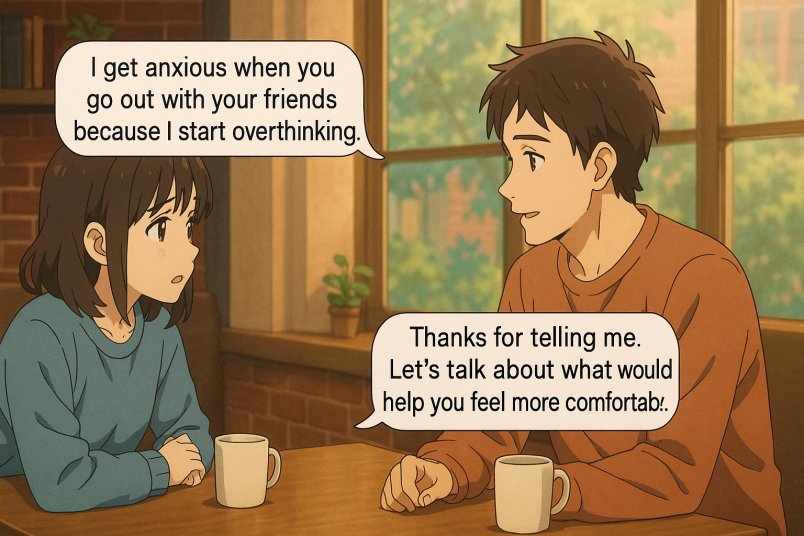
How to get over jealousy in a marriage is about understanding when you feel your relationship is under threat. That’s when our defensive emotions are triggered, and you might feel a surge of jealousy.
One way to manage fear and anxiety is to meet them head-on. Don’t try to suppress them, as that makes them stronger. Instead, you get to know them by experiencing and talking about them.
Here’s what you can do:
- Identify what specifically makes you feel threatened or insecure.
- Share your feelings with your partner using “I feel” statements.
- Listen to their perspective without interrupting or defending yourself.
3. Practice meditation
A powerful method for getting to know our emotions and how our thoughts interact with them is meditation. Contrary to popular belief, meditation isn’t about clearing the mind. It’s about getting to know the mind and its patterns of thought.
The more you sit with your mind and observe the feelings and thoughts it creates from emotions, the more you’ll distance yourself from emotions. With time, you can shift unhelpful thoughts and let go of emotions such as jealousy in a marriage.
Here’s what you can do:
- Set aside 5–10 minutes each day for quiet reflection.
- Try guided meditations focused on emotional balance.
- Notice your thoughts without judging or reacting to them.
RELATED READING : Improve Your Relationship with Mindfulness and Meditation
4. Be mindful
Mindfulness often goes with meditation. With both, you are being present in whatever experiences you’re feeling, both in the body and the mind. As you become more mindful, you allow yourself to step away from the emotions.
In essence, learning how to stop being jealous in marriage starts with processing the emotion. Mindfulness is a mind-body practice that lets you breathe into the emotion so that you can let it go.
Here’s what you can do:
- Focus on your breathing when you start feeling jealous.
- Bring attention to your surroundings to ground yourself in the moment.
- Practice being fully present during conversations with your partner.
RELATED READING : Strengthening Bonds Through Mindfulness in Relationships
5. Challenge your negative thoughts
How to stop being a jealous wife or husband can also be done with some thinking work. Emotions only become a problem when we create stories and attach thoughts to them, and those thoughts are often distorted or exaggerated.
Try challenging your thoughts by putting them “on trial” and looking for real evidence for and against them. This helps you see situations more clearly instead of jumping to conclusions.
How to overcome jealousy in a marriage isn’t just about changing your thoughts. Journaling can also help you process emotions and work through them with more calm and clarity.
Here’s what you can do:
- Write down your jealous thoughts and question their accuracy.
- Ask yourself, “What facts actually support this feeling?”
- Replace exaggerated thoughts with balanced, realistic ones.
RELATED READING : 10 Ways to Let Go of Negative Thoughts in a Relationship
6. Get to know your triggers
Overcoming jealousy in a marriage also involves understanding what sets off your jealousy. If it’s social media, you and your partner need to agree on what’s okay and what’s not for how you interact online.
If certain people or exes trigger your jealousy, talk to your partner and find ways that feel safe for you both. Perhaps you can all meet in a group setting rather than having your partner go off solo.
Here’s what you can do:
- Keep a journal of moments when jealousy arises.
- Discuss boundaries that help you feel secure.
- Limit exposure to situations that feed your jealousy.
RELATED READING : 11 Ways to Successfully Navigate Triggers in Your Relationship
7. Develop a self-care routine
Jealousy and insecurity in marriage are complex emotions that can overwhelm us if we don’t take care of ourselves. Moreover, self-compassion is part of self-care, which is now understood to be a key driver for building self-esteem.
Research shows that high self-esteem enhances the quality of romantic relationships and positively impacts the happiness of both partners. However, similarity in self-esteem levels does not affect satisfaction. The benefits of self-esteem appear linked to secure attachment and feeling valued by a partner.
Taking time to rest, pursue hobbies, or simply do things that make you feel good helps you reconnect with your own worth. When you feel balanced and fulfilled, jealousy loses much of its power.
Here’s what you can do:
- Schedule regular “me time” to recharge emotionally.
- Exercise, eat well, and rest to support emotional health.
- Practice self-kindness instead of self-criticism.
8. Find your safe place
So, how can you find your self-compassion? With jealousy, you have an opportunity to show yourself self-compassion. First, remind yourself that you’re human and that it’s perfectly okay to get emotions, no matter how terrible they feel.
Secondly, motivate yourself to let go of jealousy. You can do this by reframing the situation and looking for the positive. Another approach is to consider what you can do to nurture and improve your relationship.
If you’re defensive, your partner can shut down. Jealousy and trust issues in marriage are simply not attractive traits. On the other hand, if you are nurturing and compassionate, you’re more likely to draw your partner back in.
Here’s what you can do:
- Take a few deep breaths when emotions feel overwhelming.
- Visualize a calm, safe place in your mind.
- Focus on nurturing thoughts rather than defensive reactions.
RELATED READING : The Power of Feeling Safe in a Relationship & How to Get There
9. Understand your beliefs
So, how can jealousy be overcome in a marriage? It means understanding your beliefs about relationships, yourself, and life in general.
For example, do you believe that you and your spouse should do everything together, or is it okay to have separate friends? What about how you split your household roles?
It’s very difficult to break away from the conditioning of our past, but it starts with reflection. List all your beliefs about relationships and life, and then reflect on the helpful and the not-so-helpful ones.
How can you then rephrase the unhelpful ones? If you can do that, you will achieve a major victory in overcoming relationship jealousy.
Here’s what you can do:
- Write down your core beliefs about love and trust.
- Identify which beliefs create fear or jealousy.
- Reframe limiting beliefs into supportive ones.
10. Talk to a friend
As mentioned, jealousy and insecurity in marriage can come from distorted thoughts where we misinterpret situations. A great way to counteract those thoughts is by asking a good friend what their conclusions are.
Make sure you choose a mature and impartial friend, though. Talking things out can help you gain perspective and calm your emotions. Sometimes, hearing a grounded point of view is all it takes to see things more clearly.
Here’s what you can do:
- Choose a mature, neutral friend who will listen without judgment.
- Share your concerns honestly, but avoid partner-bashing.
- Ask for their objective perspective to help you see clearly.
11. Practice gratitude
Refocusing on the positives is one way to overcome jealousy and insecurity in a marriage. Our minds have a negativity bias, and jealousy can suck us down into a hole of despair.
It takes effort, but you can balance the negativity by forcing yourself to list things you’re grateful for in the relationship.
Here’s what you can do:
- List three things you appreciate about your partner daily.
- Express your gratitude directly to them.
- Reflect on positive moments in your marriage before bed.
RELATED READING : 10 Ways to Show Gratitude to Your Spouse
12. Leverage grounding techniques
As explained, jealousy in a marriage can lead to intense emotions that make us reactive. Another way to calm those emotions and create some distance is by using grounding techniques. Play around with them and find the ones that work for you.
Simple practices like deep breathing, focusing on your senses, or repeating calming affirmations can help you stay present. Over time, these techniques train your mind to respond with clarity instead of impulse.
Here’s what you can do:
- Use the 5-4-3-2-1 method to focus on your senses.
- Practice slow, deep breathing to reduce tension.
- Repeat calming affirmations like “I am safe right now.”
13. Befriend your emotions
How to stop being jealous in marriage is about meeting your jealousy. Get to know it. So, what does it look like if you had to give it a shape, color, or texture?
Be as creative as possible, and then talk to it. What is it protecting you from, and how can you work together rather than against each other?
This is one approach for creating distance with jealousy to make it easier to let it go.
Here’s what you can do:
- Imagine jealousy as a character and talk to it with curiosity.
- Ask what it’s trying to teach or protect you from.
- Practice self-compassion instead of judgment when it appears.
RELATED READING : 10 Tips for Accepting Your Emotions in a Relationship
14. List your strengths and positive traits
Learning how to stop being jealous can also involve appreciating what you bring to the relationship. Jealousy tends to focus on our weaknesses. Instead, refocus your mind and list all your positive traits and strengths.
Reminding yourself of your value helps shift your mindset from comparison to confidence. The more you recognize your worth, the less space jealousy has to grow.
Here’s what you can do:
- Write down qualities you love about yourself.
- Remind yourself of past successes and kind actions.
- Share your strengths by showing care and support to your partner.
Watch this TED Talk in which Dr. Janie Lacy shares three key steps to break free from toxic relationship patterns and build healthier, more compassionate connections:
15. Work with a therapist
If all else fails, the key to not being a jealous partner is getting a therapist. You can still work through all the above points, but often, we also need some professional help.
A therapist will keep you on track, act as a sounding board, and give you even more tools to practice letting go of jealousy.
Here’s what you can do:
- Find a licensed couples or individual therapist.
- Be open about your feelings and goals for therapy.
- Practice the techniques your therapist recommends consistently.
Moving forward and managing jealousy
Jealousy can feel heavy, can’t it?
It sneaks in quietly, feeding doubts you never meant to grow. But the truth is, learning how to get over jealousy isn’t about pretending those feelings don’t exist—it’s about understanding them, softening toward them, and choosing trust anyway.
It takes patience, kindness, and a willingness to see yourself and your partner with more compassion. Every time you pause, breathe, and communicate instead of react, you’re already healing. Little by little, love starts to feel lighter again… more real, more grounded, and far less shaken by fear.
Helpful?
Continue exploring this topic

Marriage.com AI: Your Relationship Guide
Talk through what's on your mind.
Automated
YOU COULD START WITH
Share this article on
Marriage.com Editorial Team
Relationship & Marriage Advice
The Marriage.com Editorial Team is a group of experienced relationship writers, experts, and mental health professionals. We provide practical and research-backed advice on relationships. Our content is thoroughly reviewed by experts... Read more to ensure that we offer high-quality and reliable relationship advice. Read less
 Reviewed by
Marriage.com Community
Real people. Real relationships. No judgment.
How do couples survive big life stress without turning on each other?
Have you navigated this in your own relationship?
Your perspective could help thousands of couples.
See what people are saying
Your perspective could help thousands of couples.


Recent Articles


Related Quizzes







 We'd love your feedback!
 Thanks for your feedback!