




Unresolved Conflict in Relationships: 3 Recurring Cycles

Reviewed By
Kristen Failla, LMFT
 Review Board Member
|
By
LMFT
Review Board MemberKristen is a Licensed Marriage and Family Therapist who provides mental health care for individuals, couples and families. She is particularly passionate about working with... Read More
Marriage.com Editorial Team

The Marriage.com Editorial Team is a group of experienced relationship writers, experts, and mental health professionals. We provide practical and research-backed advice on relationships. Our content is thoroughly reviewed by experts to ensure that we offer high-quality and reliable relationship advice.
Learn about Our Editorial Process
Updated: 27 Jul, 2026
Heal & Grow Daily for a Happier Relationship
Subscribe FREETable of Contents
View more
You know the feeling before the sentence is even finished: this again. A disagreement about who forgot to book the appointment turns, three minutes in, into the same fight about feeling unsupported that you’ve had a dozen times before.
According to Kristen Failla, LMFT, “Conflicts may also feel unresolved because couples do not feel validated, empathized with, or understood fully, thus causing the topic to continue to persist until these needs are met.”
According to a Marriage.com survey of 2,399 U.S. adults in committed relationships, 4 in 10 couples (40%) say old arguments resurface during new fights. That recognizable, almost scripted quality isn’t a coincidence. It’s usually a sign the original issue was never actually resolved, just paused.
Why do the same arguments keep coming back?
Recurring arguments usually mean the underlying issue was set aside rather than settled. A disagreement can end (voices lower, the room goes quiet, everyone moves on) without the actual problem being addressed, and when that happens, the same friction is still there waiting for the next opportunity to resurface.
Kristen Failla, LMFT, highlights that “Couples often repeat arguments because they are debating surface-level issues (the facts, who is right, wrong, who said what and when, etc.) instead of getting to the deeper root (emotions like fear, inadequacy, worry, etc.).”

The same survey found that fully resolved conflict is closer to the exception than the rule. Only 16.5% of respondents said their arguments are always resolved, while 18.7% said arguments are rarely resolved, and a further share said they’re never resolved.
For most couples, resolution is inconsistent rather than reliable, which is exactly the condition that lets old arguments keep resurfacing in new ones.
The 3 cycles that keep conflict unresolved
Not every unresolved argument looks the same. Three patterns show up most often, and each one ends the disagreement without actually resolving it.
1. The avoidance loop
One partner shuts down, refuses to talk, or the issue gets sidestepped without either partner naming it. In the survey, this is the single most common pattern: 36.5% said one partner shuts down during disagreements, and another 13.1% said the issue simply gets sidestepped.
The fight stops, but nothing about the underlying problem changes, so it’s still there the next time a related situation comes up.
If this sounds like your relationship, our guides on how to deal with a conflict-avoidant partner and how to respond to stonewalling go deeper on this specific pattern.
2. The surface-resolve loop
The disagreement appears to end in agreement, but only because one partner conceded to make the discomfort stop. Nearly 1 in 5 couples (19.1%) said one partner typically “gets their way” in disagreements.
It can look like resolution from the outside: the argument ends, things go quiet, life continues.
But the partner who conceded usually hasn’t changed their mind, just decided the conflict wasn’t worth continuing. That unaddressed disagreement tends to resurface later, often with more charge behind it.
3. The escalation loop
Instead of settling, the disagreement grows louder, more personal, or spills into unrelated grievances. This is where old arguments most visibly resurface mid-fight: a conversation about weekend plans becomes a rehash of a financial disagreement from months ago.
The pattern feeds itself, since an escalated, emotionally flooded argument is the hardest kind to actually resolve, which sets up the next recurrence.
For ways to keep a disagreement from tipping into this loop, see how to handle an argument in a relationship.
Why does staying stuck in these cycles feel easier than resolving conflict?
Because each of these cycles ends the immediate discomfort of the disagreement, even though it doesn’t address what caused it, and avoiding discomfort is a stronger short-term pull than working through it.
Once a couple settles into demand-withdraw as their default, the withdrawing partner’s shutdown ends that specific conversation. But it also guarantees the topic will need to be raised again later.
Unresolved conflict doesn’t just stay emotional, either. In that same Ohio State study, married couples who showed more hostility during a conflict discussion healed a small standardized wound measurably slower over the following weeks.
This was true compared to couples who discussed the same disagreement with less hostility. Repeated, unresolved conflict has a physical cost, not just a relational one.
There’s also a cognitive piece. Research on “serial arguments,” the term for recurring disagreements on the same topic, has found that rumination (continuing to mentally replay an unresolved argument) tends to increase a person’s motivation to bring the topic up again, rather than let it go.
In other words, the more an unresolved disagreement gets turned over privately, the more likely it is to resurface out loud.
What does actual conflict resolution look like?
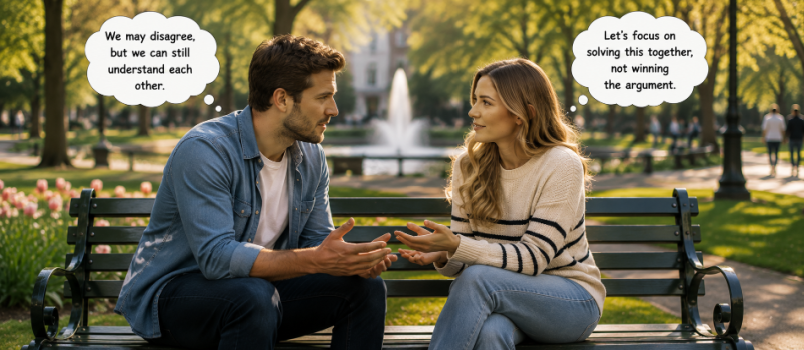
Real resolution doesn’t require agreeing on everything. It requires both partners feeling like the issue was actually addressed, not just outlasted. A few frameworks help:
Kristen Failla, LMFT, adds that,”If you are arguing about the dishes, yet again, it might be time to consider what exists underneath (what do the dishes symbolize? What meaning does having them done or undone carry for you? What is the deeper feeling?)
Oftentimes, a conflict about invisible labor or a longing to be appreciated is being disguised by a chore.”
- Name the cycle, not just the topic. Instead of re-litigating who forgot the appointment, try naming the pattern: “I think we’re in the same loop we always get into with scheduling. Can we talk about that instead?” This shifts the conversation from the surface issue to the actual recurring dynamic.
- Use a specific return time, not “later.” If a conversation needs to pause (either partner is flooded, or the timing is genuinely bad), agree on when you’ll come back to it. “Later” without a specific time tends to become “the avoidance loop” in practice.
- Separate venting from problem-solving. Some conversations need to happen twice: once to be heard, and once to actually solve the practical problem. Trying to do both at once often stalls out in the emotional part and never reaches resolution.
- Check whether “resolved” meant “conceded.” After a disagreement ends, ask directly: does this feel settled to both of us, or did one of us just stop pushing? See avoiding conflict in relationships for subtler signs of this pattern.
- Get outside support for long-running cycles. If the same argument has resurfaced for months or years, a licensed couples therapist can help identify which cycle is in play. See 5 steps to resolve conflict with your partner for practical frameworks.
For more on the specific handling styles behind these cycles, see our companion piece on how couples handle conflict.
If a specific unresolved issue keeps resurfacing in your relationship, our communication course walks through frameworks for staying in a disagreement long enough to resolve it, or you can find a therapist who specializes in couples’ conflict work.
FAQs
Why do old arguments resurface during new fights?
Because the original issue was paused rather than settled. Roughly 4 in 10 couples report that old arguments resurface during new disagreements, which usually happens when a past conflict ended through shutdown, one-sided concession, or escalation rather than genuine resolution.
Is it normal to have the same argument over and over?
It's common, and it's a signal worth paying attention to rather than a sign something is unusually wrong. Recurring arguments on the same topic (sometimes called serial arguments) typically point to an unresolved underlying issue rather than a series of unrelated disagreements.
What's the difference between avoiding conflict and resolving it peacefully?
Avoidance ends the disagreement without addressing the issue, often through one partner shutting down or the topic quietly dropping. Genuine resolution means both partners feel the issue was actually worked through, even if the conversation was uncomfortable.
A calm ending isn't automatically a resolved one. It's worth checking whether the calm came from resolution or from one partner conceding.
Can unresolved conflict affect health, not just the relationship?
Research on marital conflict has found physical effects tied to hostile, unresolved conflict patterns, including slower wound healing in couples who showed more hostility during a disagreement.
This was compared to couples who discussed the same kind of issue with less hostility. Chronic unresolved conflict appears to carry a physical cost alongside the relational one.
How do you actually resolve conflict instead of just ending the argument?
Useful approaches include naming the recurring pattern instead of just the surface topic, agreeing on a specific time to return to a paused conversation, and separating venting from problem-solving.
Also try directly checking whether an ending felt resolved or just conceded. For cycles repeated over months or years, a licensed therapist can help build a different pattern.
The cycle can change, even if it’s been going on for years
Recurring arguments can feel like proof that a couple is fundamentally mismatched, but more often they’re proof that the same unresolved issue hasn’t found a way to actually get addressed yet.
Avoidance, one-sided concession, and escalation all end the argument in front of you. None of them end the one waiting underneath it.
Naming which cycle you tend to fall into is usually more useful than trying to win the current argument outright. The goal isn’t a relationship with no disagreements. It’s a relationship where disagreements, once they happen, actually get to finish.
Helpful?
Continue exploring this topic

Marriage.com AI: Your Relationship Guide
Talk through what's on your mind.
Automated
YOU COULD START WITH
Share this article on
Marriage.com Editorial Team
Relationship & Marriage Advice
The Marriage.com Editorial Team is a group of experienced relationship writers, experts, and mental health professionals. We provide practical and research-backed advice on relationships. Our content is thoroughly reviewed by experts... Read more to ensure that we offer high-quality and reliable relationship advice. Read less






 We'd love your feedback!
 Thanks for your feedback!