




Why Do Couples Fight More When They’re Actually Happy | Science Explains

By
Owen Kessler, Author
Talented writer Owen simplifies complex topics, focusing on psychology and personal growth. He enjoys camping in scenic mountains, traveling, and embracing diverse cultures.
Learn about Our Editorial Process
100 Reads
Updated: 22 May, 2026

Heal & Grow Daily for a Happier Relationship
Subscribe FREETable of Contents
View more
Key Takeaways
“Can you just tell me earlier next time?”
“I did tell you. You just didn’t listen.”
Sound familiar? Most people hear an exchange like that and think: this is what a struggling relationship sounds like.
But science says something that completely flips that assumption. Happy couples actually fight more. And understanding why that is true might be one of the most useful things you ever learn about relationships.
This article is part of Marriage.com’s Science Says series, where we break down surprising, research-backed truths about how relationships actually work. In episode one, we are tackling one of the most persistent myths in relationship advice: that fewer arguments mean a better relationship.
The myth of the conflict-free relationship

Join millions building healthier, happier relationships.
 Subscribe
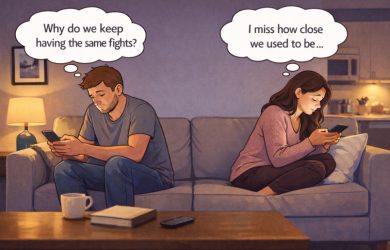
Most of us carry a picture in our heads of what a healthy relationship looks like, and in that picture, couples do not argue much. No tension, no raised voices, no difficult conversations that stretch into the evening. Just warmth, agreement, and smooth coexistence.
It sounds like the goal. But research consistently tells a different story. The absence of conflict in a relationship is not necessarily a sign of harmony. It is often a sign of avoidance. And avoidance, over time, does far more damage to a relationship than the arguments people are trying so hard to prevent.
When couples stop bringing things up, when frustrations go unexpressed and needs go unstated, the relationship does not become more peaceful. It becomes more distant. Every unspoken thing builds a small increment of emotional space between two people.
And because it happens gradually, neither partner often notices exactly when they crossed from “keeping the peace” to “quietly disconnecting.”
This is one of the core reasons why couples fight in the first place: not because they are incompatible, but because they are two different people with genuine differences, and those differences need somewhere to go. The choice is not really between conflict and peace. It is between conflict that happens openly and conflict that goes underground.
What silence actually costs a relationship
Here is the part most people do not anticipate. Avoiding conflict does not eliminate the feeling that created it. It just removes the outlet. The frustration, the unmet need, the thing that needed to be said, all of it is still there. It just starts expressing itself sideways.
It shows up as a slightly sharper tone when you are tired. A pulling back during moments that should feel close. A growing sense that your partner does not really know what you are going through, and maybe could not handle it if they did. And both partners, without ever identifying it as such, are experiencing emotional distance that they did not consciously choose.
This is what the research points to: silence can damage a relationship more than conflict ever does. Not because conflict is painless, but because the alternative to honest conflict is not peace. It is slow disconnection.
Two people who used to fight, and then stopped, are not always couples who found harmony. Sometimes they are couples who found indifference.
The couples who stay genuinely close over years and decades are not the ones who never disagree. They are the ones who have learned to stay emotionally engaged with each other even when engagement is uncomfortable.
What “fighting more” actually means
When science says happy couples fight more, it does not mean they are louder, more volatile, or more hurtful to each other. The distinction is important, because the quantity of conflict matters far less than the quality of it.
What happy couples do more of is express frustration when they feel it, raise concerns before they become resentments, and have the kinds of honest conversations that less connected couples avoid. They have learned that healthy fighting in a relationship is not the same as destructive fighting. It is not about winning or causing pain. It is about staying honest with each other.
In practical terms, healthy conflict looks like this:
Expressing frustration without attacking the person. “I felt left out when that happened” is very different from “You always do this.” One addresses a specific feeling. The other attacks character, which makes the other person defend rather than listen.
Listening to adjust, not just to respond. In healthy conflict, both partners are genuinely trying to understand what the other person is experiencing, not just waiting for their turn to make their point. This is what allows a disagreement to actually move somewhere rather than going in circles.
Repairing after conflict. Perhaps the most important marker of healthy conflict is what happens after it. Happy couples repair. They come back together, acknowledge what happened, and restore the emotional connection. The fight itself is not the damage. Unrepaired conflict is the damage.
Staying engaged rather than withdrawing. The instinct to shut down during conflict, to go quiet, leave the room, or give the silent treatment, feels protective in the moment but consistently makes things worse over time. Staying emotionally present, even imperfectly, keeps the connection alive in a way that withdrawal never does.
Why emotional engagement is the real goal
The deeper principle behind the science is this: what separates happy couples from struggling ones is not the absence of conflict. It is emotional engagement.
Emotionally engaged couples notice each other. They register when something is off. They bring things up because they care enough to stay connected through discomfort. They argue, but they also listen, adjust, and come back to each other.
Emotionally disengaged couples may have far fewer arguments. But they are also having far fewer real conversations. The relationship has become a parallel arrangement, where two people share a life without particularly sharing themselves.
Conflict resolution skills are not about eliminating disagreements from a relationship. They are about making disagreements safe enough to have, productive enough to actually resolve something, and short-lived enough not to fester into the kind of resentment that quietly hollows a relationship out.
The goal is not a relationship with no friction. The goal is a relationship where friction does not have to be feared, because both people know how to move through it together.
What to do with this insight practically
If you are someone who has been avoiding conflict in your relationship because you thought that was the healthier choice, this reframe is an invitation. Not to pick fights, but to stop treating every uncomfortable truth as a threat to the relationship.
A few practical starting points:
Name small things before they become big things. The frustration that goes unexpressed today becomes the resentment that explodes three months from now. Raising something small and specific while it is still small takes far less emotional energy and causes far less damage than waiting until it is impossible to ignore.
Separate the topic from the relationship. Disagreeing about something does not mean the relationship is in danger. Two people who genuinely care about each other will disagree regularly. The disagreement is not evidence of a problem. How it is handled is what determines whether it strengthens or weakens the connection.
Make repair a habit, not an exception. After a difficult conversation or argument, come back together deliberately. A simple acknowledgment, “that was hard, but I’m glad we talked about it,” goes a long way toward signaling that the relationship survived the conflict intact.
Check in on what is going unsaid. If you and your partner have not had a genuinely honest conversation in a while, that is worth noticing. Not because something is necessarily wrong, but because the absence of friction sometimes means the absence of real engagement. Ask how they are actually doing. Answer honestly when they ask you.
Understanding how often couples fight in a healthy relationship comes down to a simple reframe: it is not about the number of arguments. It is about whether both people feel safe enough to be honest and skilled enough to work through what comes up.
Common questions about why do couples fight
Not at all. In fact, the absence of any conflict is often a more concerning sign than occasional disagreement. Conflict that is rooted in genuine care, "I need you to understand how this affected me," is a form of emotional investment. Two people who are truly indifferent to each other rarely bother to argue. Healthy conflict stays focused on the specific issue, uses "I" statements rather than character attacks, involves genuine listening on both sides, and ends with some form of repair or resolution. Unhealthy conflict escalates into contempt, criticism, or stonewalling, revisits old grievances without resolution, and leaves both partners feeling worse and further apart than before. Consistent conflict avoidance by one partner is worth addressing directly, ideally in a calm, low-stakes moment rather than in the middle of a disagreement. Let your partner know that you feel closer and more secure when you can talk through things honestly, and that avoidance makes you feel more disconnected than the actual fight would. If this pattern is persistent, couples therapy can be genuinely useful for building the communication safety that makes engagement possible. Does fighting mean we are not compatible?
What is the difference between healthy and unhealthy fighting?
What if my partner refuses to engage in conflict at all?
Final thoughts
The next time you and your partner argue, try holding onto this: the fact that you are still engaging is itself a form of connection. It means you care enough to be frustrated. You are invested enough to want things to be different. You have not slipped into the quiet indifference that does far more damage than any argument.
Happy couples fight. They express frustration, listen, adjust, and repair. And in doing all of that, they stay close in a way that avoidance never allows.
Watch the full Marriage.com video on why happy couples fight more, and share your thoughts in the comments below. Has this changed the way you think about conflict in your own relationship? We read every response, and yours might be exactly the perspective someone else needs today.
Helpful?
Continue exploring this topic

Marriage.com AI: Your Relationship Guide
Talk through what's on your mind.
Automated
YOU COULD START WITH
Share this article on
Owen Kessler
Author
Owen Kessler is a talented writer with a knack for making complex topics easy to understand. He has a particular interest in psychology and personal growth, and his writing is known for its insightful commentary on these subjects.... Read more When he’s not writing, Owen enjoys spending time camping in the beautiful mountains and forests that surround his home. He also loves to travel and has a deep appreciation for the diversity of cultures he encounters on his journeys. Read less
 Reviewed by
Marriage.com Community
Real people. Real relationships. No judgment.
How do I talk to my partner about something that bothers me without sounding like I’m attacking them? Every time I try, it blows up.
Have you navigated this in your own relationship?
Your perspective could help thousands of couples.
See what people are saying
Your perspective could help thousands of couples.


Recent Articles


Related Quizzes






 We'd love your feedback!
 Thanks for your feedback!