




How To Communicate With Your Spouse: 5 Strategies That Help

By
Rachael Pace, Author
Rachael Pace inspires with motivational articles on loving partnerships. She encourages making room for love and facing challenges together.
Learn about Our Editorial Process
8.3k Reads
Updated: 25 Sep, 2026

Heal & Grow Daily for a Happier Relationship
Subscribe FREETable of Contents
View more
Key Takeaways
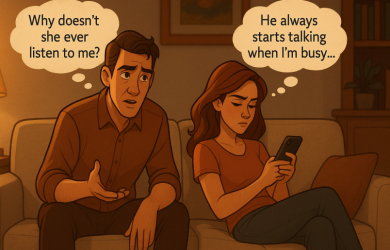
You mention something that happened at work, and your spouse says “mm-hm” without looking up from their phone. Later, they tell you about a call with their sister while you’re half-answering an email. Nobody fought, but you both ended the evening a little lonelier.
Learning how to communicate with your spouse starts with small, everyday moments like these. Listen to understand rather than to reply, and put the phone down.
Use “I” statements that acknowledge their side. Ask what makes them feel loved, say no kindly, and respond warmly to good news, not only to problems.
What Does Good Communication With Your Spouse Look Like?
Good communication means you both feel heard, you can each say what you need, and you come away understood, even when you don’t agree.
Couples who communicate well still disagree, and they don’t necessarily talk a lot. Some couples talk for hours and still feel unheard, while others say little and understand each other well. The test is whether your spouse hears what you meant to say.
How To Communicate With Spouse: 5 Strategies
These five strategies are the ones we’ve chosen to focus on, because each is something you can start using today. You don’t have to work on all five at once. Start with the one that fits what feels most missing between you right now.
1. Listen to understand, not to reply
It’s easy to listen with half your attention on what you’re going to say next. While your spouse talks, make understanding them your only job. When they pause, say back what you heard in a sentence, and ask whether you got it right before you add anything of your own.
Jumping to advice is an easy trap. If your spouse is describing a stressful day, a fix can land as “stop talking about it.” Ask first: “Do you want ideas, or do you want me to listen?”
Rebekka Kuhn and colleagues, publishing in the Journal of Family Psychology, observed 365 heterosexual couples during 8-minute conversations in which one partner discussed a stressful experience. They found that attentive listening was linked with better coping as a couple and higher relationship satisfaction.
It’s a link rather than proof of cause, but it suggests stressful moments are one place where listening makes a spouse feel supported.
- But wait: What if your spouse doesn’t want to talk when you ask? Don’t press. Tell them you’ll be around later, and bring it up again at a quieter moment. Some people need time to sort out what they think before they can say it.
RELATED READING : How to Be an Active Listener in a Relationship: 13 Tips
2. Say it with “I,” and include their side

“You never deal with the bills,” invites a defense. “I’ve been feeling stretched thin keeping track of the bills on my own,” invites a conversation. The second describes your experience instead of their character.
Blame hidden inside an “I” statement still lands as blame. “I feel like you don’t care” begins with “I,” but the message is accusatory. Adding your spouse’s side can help even more.
- But wait: If your spouse gets defensive anyway, don’t repeat the point louder. Say you’re not trying to blame them, and ask what would make the bills easier from their side. Then listen to the answer.
RELATED READING : What Are “I” Statements in Relationships? Benefits & How to Use
3. Ask what makes them feel loved, instead of guessing
People tend to have favorite ways of feeling cared for, such as kind words, time together, touch, small gifts, or help with everyday tasks. Naming these can give you words for something you’ve both felt.
How to better communicate with your wife? Or how to communicate better with your husband?
The simplest way is to ask: “What’s something I did this week that made you feel appreciated?”
Then ask the reverse question about something that didn’t land. People’s answers change with stress, seasons of life, and what’s going on between you, so ask more than once.
Notice what your spouse keeps doing for you, too. A spouse who keeps planning time together may be hinting at what they value, though it’s still worth asking rather than assuming.
- But wait: Be careful about locking your spouse into one category. “You like to help around the house, so I did the dishes,” can miss what they needed that night.
4. Say no clearly and kindly
When you say yes to everything and then resent it, the resentment tends to come out later, in short answers or a sudden argument about something else.
A clear no comes with what you can offer instead. For example, “I can’t take on the dinner party this month, but I can handle the grocery run for it.” Keep the explanation short. A long list of reasons can sound like you’re asking for permission, and it gives your spouse points to argue with.
If your spouse is disappointed, let them be. You don’t have to talk them out of the feeling to hold your answer. Acknowledge it (“I know that’s not what you hoped”) and leave it there.
- But wait: When it’s your spouse saying no to you, take it as information rather than rejection, and ask what would work for them instead.
5. Respond warmly when things go right
How you respond when your spouse shares good news gets far less attention than how you handle problems, but it matters too.
Across four studies published in the Journal of Personality and Social Psychology, Shelly Gable and colleagues found that couples in which one partner usually responded to the others good news with enthusiasm reported more intimacy and higher daily satisfaction.
A warm response means stopping what you’re doing, showing you’re glad, and asking a follow-up question. “You got the promotion? That’s huge. What did your manager say?” does more than “Oh, nice,” said while scrolling.
- But wait: Try not to jump straight to the downside. “Great, but does that mean longer hours?” might be a fair question, but it can wait until tomorrow.
Watch this TED Talk by Amy Scott, a communication expert, who shares how understanding communication styles can build stronger, healthier relationships.

Why Better Communication Isn’t The Whole Fix
It’s tempting to assume good communication makes couples happy. The evidence suggests the link can run the other way, too.
Communication still matters, and it still tends to move with satisfaction. But how you talk is shaped by what else is going on, like money stress or exhaustion, as much as by your technique.
How to communicate effectively with your spouse? Look at what’s weighing on you both, as well as at your wording. You can think these through on your own:
- Has something changed recently, like work, money, health, or caring for someone, that’s left one or both of you depleted?
- Do your hardest conversations happen at the same time of day, when you’re both running on empty?
- Is there a practical problem underneath the communication problem that nobody’s named yet?
- When things were easier between you, what was different about your days?
What To Do When Your Spouse Won’t Communicate
Sometimes one of you wants to talk, and the other goes quiet. The more one pushes, the more the other pulls back, and each sees the other as the cause of the silence.
- If you’re usually the one who wants to talk, pick a calm time and ask for one specific thing, instead of listing everything that’s been bothering you. “Can we talk for 15 minutes after dinner about the weekend plans?” is easier to say yes to than “We need to talk.”
- If you’re usually the one who goes quiet, say that you need time and when you’ll come back to it. “I need to think about this. Can we pick it up tomorrow night?” tells your spouse the conversation isn’t over.
- If you’re both stuck, name the pattern together at a calm moment rather than in the middle of it. Something like “I think I push when you pull back, and you pull back when I push” makes the pattern the problem, rather than either of you.
RELATED READING : 6 Steps to Effective Communication in Relationships
When Talking To Your Spouse, You Feel Unsafe
If you’re afraid of your spouse or in immediate danger, help is available. You can call the National Domestic Violence Hotline at 1-800-799-7233, text START to 88788, or call 911 in an emergency.
The strategies in this article assume both of you feel safe enough to speak up. They aren’t designed for relationships where one person uses threats, intimidation, or control. Better wording won’t fix that.
These questions are for you alone:
- Do I stay quiet about things that matter because I’m worried about how my spouse will react?
- Has a conversation ever ended with threats, breaking things, or physical force?
- Do I need permission to see friends, spend money, or go places?
- After we talk, do I feel scared rather than frustrated?
If some of these ring true, a trained advocate can help you think through your options. People in this situation make different choices: some leave, some stay and get support, and some aren’t sure yet. Only you can weigh your situation.
An advocate can also explain what safety planning generally entails, regardless of which path you’re considering.
When To Get Help
If the same conversations keep going in circles, or you’ve stopped trying to talk about certain things at all, a counselor can help. That’s a practical step, and it doesn’t mean you’ve failed.
If your spouse won’t go, going on your own can still help you understand your side of the pattern and try different responses. You can search the Marriage.com therapist directory for a counselor who works with couples, or start with structured practice at home.
FAQs
Still have questions about how to talk to your spouse? These short answers cover common ones, from handling a spouse who shuts down to whether love languages help.
Pick a calm time and ask for one specific, short conversation rather than a big talk. If you tend to be the one who withdraws, say when you'll come back to it. The pattern of one partner pushing and the other pulling back with lower satisfaction, so it's worth naming together. Open with "I" language and acknowledge their view before you make your point. The participants weren't couples, but the phrasing is easy to try. It can give you both useful words for what makes each of you feel valued. Preferences shift over time, though, so it's better to ask than to rely on one label. A simple question like "What made you feel appreciated this week?" is an easy place to start. Common signs include feeling unheard, having the same conversations over and over without progress, and avoiding certain topics altogether. Phones at the table and conversations that happen only about logistics are also worth noticing. What do you do when your spouse won't communicate?
How do I talk to my spouse without them getting defensive?
Does knowing how your spouse likes to feel cared for help communication?
What are the signs of poor communication in a marriage?
Start With One Conversation
How to communicate with your spouse? You don’t have to change how the two of you talk overnight.
Pick one strategy and try it this week, maybe putting your phone face down the next time your spouse starts telling you about their day, or asking what made them feel appreciated lately.
Notice what shifts, even if it’s small. If a conversation goes badly, it can still show you where to try something different next time. Communicating with your spouse tends to get easier with practice, and every calm, attentive moment gives the two of you a little more to build on.
Helpful?
Continue exploring this topic

Marriage.com AI: Your Relationship Guide
Talk through what's on your mind.
Automated
YOU COULD START WITH
Share this article on
Rachael Pace
Author
Rachael Pace is a noted relationship writer associated with Marriage.com. She provides inspiration, support, and empowerment in the form of motivational articles and essays. Rachael enjoys studying the evolution of loving partnerships... Read more and is passionate about writing on them. She believes that everyone should make room for love in their lives and encourages couples to work on overcoming their challenges together. Read less
 Reviewed by
Marriage.com Community
Real people. Real relationships. No judgment.
How do I talk to my partner about something that bothers me without sounding like I’m attacking them? Every time I try, it blows up.
Have you navigated this in your own relationship?
Your perspective could help thousands of couples.
See what people are saying
Your perspective could help thousands of couples.



Recent Articles


Related Quizzes








 We'd love your feedback!
 Thanks for your feedback!