




What Is Avoidant Attachment Style? Causes, Signs & Healing Explained

By
Marriage.com Editorial Team
The Marriage.com Editorial Team is a group of experienced relationship writers, experts, and mental health professionals. We provide practical and research-backed advice on relationships. Our content is thoroughly reviewed by experts to ensure that we offer high-quality and reliable relationship advice.
Learn about Our Editorial Process
100 Reads
Updated: 10 Jul, 2026

Heal & Grow Daily for a Happier Relationship
Subscribe FREETable of Contents
View more
Key Takeaways
There is a particular kind of loneliness that gets almost no airtime. Not the loneliness of being physically alone, but the loneliness of being in the presence of someone who genuinely wants closeness with you, someone you want to be close to as well, and finding that something internal keeps the distance intact regardless of how much you both want otherwise.
If that resonates, you have likely spent time explaining it to yourself in ways that are partially true but incomplete. You need independence. You process things internally. Emotional intensity is not your natural mode. None of those explanations are entirely wrong. But none of them reach the actual root of what is happening.
That root is older than any relationship you have been in. It is called avoidant attachment style, and understanding it clearly is the first real step toward changing it, whether you are the person running the pattern or the person in a relationship with someone who is.
What causes avoidant attachment style
Avoidant attachment style does not typically develop through dramatic or obviously traumatic experiences. It forms through something quieter, which is partly why it is so difficult to identify later in life.
The common thread is a caregiving environment where expressing emotional needs consistently produced little to no emotional response. Not punishment, not hostility, simply an absence of useful return. A parent who was dependable in practical terms, present in the physical sense, and largely unavailable in the emotional one.
In that context, a child draws a perfectly reasonable conclusion: if showing a need does not result in that need being met, and if it noticeably makes the people around you uncomfortable, then the most rational adaptation is to stop showing it.
That child then gets described by adults as independent, easy, mature beyond their years. They receive genuine admiration for a coping strategy that is quietly costing them something significant.
Dr. John Bowlby, whose foundational research created the entire framework of attachment theory, identified this as dismissive avoidant attachment: a childhood adaptation that gradually becomes a fully automated protection system, running in the background of every adult relationship the person enters without them consciously activating it.
The rule the nervous system internalizes is something like: let people close enough to stay, but not close enough that their loss would undo you. Because real dependence, the kind that comes from genuine intimacy, was the one thing the early environment made feel unsafe.
What avoidant attachment feels like from the inside

Join millions building healthier, happier relationships.
 Subscribe
Most accounts of dismissive avoidant attachment describe the behavior: emotional unavailability, a need for space, difficulty with vulnerability. They largely miss the interior experience, which is what makes the pattern so difficult for the person living it to recognize and address.
The first important thing to understand is that avoidant attachment is not indifference. People with this pattern often experience significant emotional depth. The difference is in what happens to those feelings once they arrive.
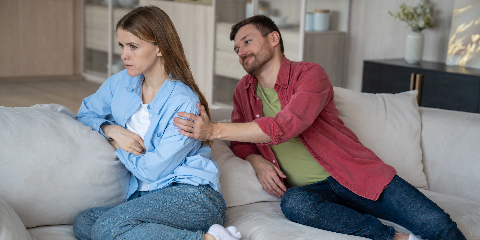
As a relationship deepens, as a partner begins wanting more access to the internal world that has been carefully managed, something activates. And it does not feel like fear, which would at least be recognizable. It tends to feel like irritation. A sudden awareness of the other person’s shortcomings that did not seem to exist the week before.
A compelling and logically convincing need for space. A quiet but persistent question about whether the relationship is actually right. The system is generating reasons to increase distance at the precise moment intimacy is increasing, because at some level of closeness, the nervous system registers connection as threat, regardless of whether any actual threat is present.
From the outside, this reads as not caring. From the inside, it feels entirely rational and justified, which is exactly what makes avoidant attachment style so difficult to interrupt from the self. The protection mechanism is very effective at what it does, including at concealing its own operation from the person running it.
How avoidant attachment affects those who love someone with it
The particularly difficult geometry of loving someone with avoidant attachment is that the pattern intensifies in direct proportion to how much the other person invests. The more consistently a partner shows up, the more loving and present they are, the more the avoidant nervous system processes that investment as something requiring management rather than something to receive.
Which means the most devoted, most patient partners end up feeling the most rejected. Not because the avoidant person does not care, but because a protection system built in early childhood cannot distinguish between genuine emotional danger and genuine emotional safety. It processes all significant closeness through the same filter, and the response is the same regardless of how safe the actual relationship is.
This is the trajectory the pattern moves toward when nothing changes. Two people in a relationship where one is consistently trying to get closer and one is consistently, often unconsciously, maintaining distance, neither of them fully understanding why the gap persists despite both wanting it to close.
For the partner on the outside of this dynamic, the most useful thing to understand is that the distance is not a statement about your worth or your lovability. It is a nervous system doing what it was trained to do in a context it was never designed for, with a person it never anticipated.
Three things that move the needle toward healing
Research and clinical work on how to heal avoidant attachment style consistently point to three levers that produce genuine, durable change rather than temporary adjustment.
Noticing the withdrawal before it completes
The avoidant withdrawal response moves faster than conscious thought. By the time awareness arrives that distance is needed, the distancing has typically already begun. The reply got shorter. The emotional temperature dropped. The partner registered the shift before either person named it.
The practice is not to stop the withdrawal immediately, which tends to create shame and further closure. It is simply to create one pause between trigger and response. Something is activating right now. The impulse is to create distance. Sixty seconds before acting on it. That single pause, repeated consistently over time, interrupts the automaticity that makes the pattern nearly invisible. Change requires visibility. The pause creates it.
Building tolerance for being known in small increments
Avoidant attachment developed because vulnerability historically produced unhelpful responses. The nervous system formed a working rule: being genuinely known creates exposure, and exposure leads to pain. What revises that rule is not intellectual insight. It is accumulated new experience.
Specifically: saying the real thing instead of the safe thing in a small moment, and having it received well. Then something slightly less small the following week. Each instance of honest disclosure that survives contact with another person without producing the feared outcome is a data point the nervous system accepts, because it is experiential rather than verbal.
This is what genuine progress with avoidant attachment looks like in practice: not a single breakthrough conversation, but a quiet accumulation of small moments where more of the truth was offered and the relationship held.
Getting curious about the withdrawal rather than fighting it
Most advice on avoidant attachment treats the withdrawal impulse as an adversary to overcome. The instruction is essentially to override it, to stay present when every internal signal says to create distance. That approach works occasionally and generates shame reliably. And shame, it turns out, is one of the most efficient ways to make an avoidant nervous system close further, because shame is a form of emotional exposure, and emotional exposure is precisely what the system was built to prevent.
What works more sustainably is genuine curiosity directed at the withdrawal when it activates. What specifically just happened? What was it about that moment that triggered this response? Was it the emotional demand of the conversation, the sense of being seen more fully than usual, or something about the present situation that echoes an older one?
That inquiry, applied consistently over time, begins to pull apart the present relationship from the original environment that created the pattern. A partner asking for closeness is not the same experience as a caregiver who was emotionally unavailable. The nervous system does not yet know that. Curiosity, practiced repeatedly, is how it learns.
What realistic change looks like
Avoidant attachment style does not disappear entirely. That is the honest version of this conversation. The nervous system that built the protection strategy over years does not dismantle it quickly.
What changes with sustained, deliberate work is the calibration of the system. The withdrawal impulse fires less frequently. When it does activate, the recovery time shortens. Most significantly, the nervous system gradually accumulates evidence for something it could not previously register: that letting someone in is survivable.
That being known by another person does not inevitably lead to loss or pain. That the wall that kept the internal world safe for years is also the thing standing between the person running it and the life and relationships they genuinely want.
One honest disclosure. One moment of staying when the instinct was to go. For someone with avoidant attachment style, none of that is small. It is the entire direction.
Common questions about avoidant attachment style
How do you know if you have avoidant attachment style versus simply being introverted?
Introversion is about energy and social preference. Avoidant attachment is about what happens internally when emotional closeness increases within significant relationships, specifically the activation of distance-creating responses when intimacy reaches a certain threshold.
An introvert can be fully emotionally available in close relationships and simply need recovery time after social activity. Someone with avoidant attachment typically experiences discomfort or an urge to withdraw specifically in response to deepening emotional connection, regardless of social context.
Does avoidant attachment style mean someone does not love their partner?
No. Avoidant attachment and the capacity for love are entirely separate. Many people with this pattern feel deeply for their partners. The challenge is that the protection system processes intimacy as threat regardless of the quality or sincerity of the feelings involved.
Understanding this distinction matters because it reframes the withdrawal from a statement about feeling into a statement about nervous system wiring, which is far more accurate and far more workable.
Is therapy necessary for healing avoidant attachment, or can someone work on it independently?
Both paths are possible. Self-directed work through deliberate practice of the three levers described above produces genuine progress for many people. Therapy, particularly attachment-focused or somatic approaches, tends to accelerate the process significantly because it provides a direct relational experience of being known and received, which is precisely the kind of accumulated new evidence the nervous system updates on.
Final thoughts
Avoidant attachment style is not a character flaw. It is not evidence of an inability to love or a fundamental preference for isolation. It is a protection system, thoughtfully built by a child navigating an environment where emotional openness did not produce emotional safety, now running on outdated programming inside a present-day relationship it was never designed for.
The three practices, building the pause, tolerating gradual disclosure, and approaching the withdrawal with curiosity rather than shame, are not a quick fix. They are a direction. And a consistent direction, followed with patience and genuine self-honesty, is how the wiring shifts, not into silence where the protection once was, but into something that finally has room for the connection that was always, underneath everything, the real goal.
Watch the full Marriage.com video on avoidant attachment style for the complete breakdown, and share in the comments below: which of the three practices feels most foreign to how you currently operate? Your answer shapes everything we make next.
Helpful?
Continue exploring this topic

Marriage.com AI: Your Relationship Guide
Talk through what's on your mind.
Automated
YOU COULD START WITH
Share this article on
Marriage.com Editorial Team
Relationship & Marriage Advice
The Marriage.com Editorial Team is a group of experienced relationship writers, experts, and mental health professionals. We provide practical and research-backed advice on relationships. Our content is thoroughly reviewed by experts... Read more to ensure that we offer high-quality and reliable relationship advice. Read less
 Reviewed by
Marriage.com Community
Real people. Real relationships. No judgment.
Do personality tests help couples understand each other or just put people in boxes?
Have you navigated this in your own relationship?
Your perspective could help thousands of couples.
See what people are saying
Your perspective could help thousands of couples.











 We'd love your feedback!
 Thanks for your feedback!