




Falling Out of Love or Just Drifting Apart? Here’s the Difference

By
Marriage.com Editorial Team
The Marriage.com Editorial Team is a group of experienced relationship writers, experts, and mental health professionals. We provide practical and research-backed advice on relationships. Our content is thoroughly reviewed by experts to ensure that we offer high-quality and reliable relationship advice.
Learn about Our Editorial Process
100 Reads
Updated: 3 Aug, 2026

Heal & Grow Daily for a Happier Relationship
Subscribe FREETable of Contents
View more
Key Takeaways
When did you last feel genuinely excited to see your partner? When did a conversation last take an unexpected turn that left you thinking about it afterward?
If those questions require some searching to answer, you are not alone, and the feeling itself is not necessarily what you think it is. The mistake most couples make at this point is assuming they already know what is happening.
Most of them are wrong, because the two most common causes of relational disconnection, falling out of love and drifting apart, feel almost identical from the inside on an ordinary Tuesday. The daily distance looks the same. The flatness feels the same. The absence of spontaneity arrived the same gradual way.
But they are not the same thing. And what you do next depends entirely on which one you are actually dealing with.
Why the distinction matters more than most people realize

Join millions building healthier, happier relationships.
 Subscribe
When couples cannot distinguish between the two, they tend to respond in one of two equally unhelpful ways: they either spiral into panic and begin pulling back from the relationship entirely, or they do nothing and wait for things to improve on their own. Neither response addresses what is actually happening.
The core difference is this. Falling out of love is a shift in how you feel toward your partner. Drifting apart is a shift in the space between you: the habits, the rituals, the small daily points of contact that create the felt sense of being genuinely in something together.
One is about internal feeling. The other is about external structure. And a structural problem can be addressed structurally, once you have correctly identified it.
The couples who figure this out before acting on their assumptions are the ones with real options.
Signs you are drifting apart, not falling out of love
The majority of couples who believe they are falling out of love are, on closer examination, experiencing drift. And drift does not announce itself. It accumulates in the background while everything else in life takes up space.
A few of the clearest indicators:
Your lives have become parallel rather than shared. Individual routines, separate interests, and independent day-to-day schedules have gradually expanded to occupy territory that used to be shared. Nobody made a deliberate decision for this to happen. It just did.
Conversations stay at the logistical surface. What needs to be done, who is picking up the kids, what is for dinner. The practical coordination of shared life is fully operational, but the last time a conversation went somewhere genuinely interesting or unexpected is difficult to recall.
The small connective gestures have faded. The mid-afternoon message that had no specific purpose. The check-in that was not about anything in particular but somehow communicated: I am thinking about you. These did not disappear in a single moment. They tapered off so gradually that their absence only becomes noticeable in retrospect.
What is important to recognize here is that none of this means love has gone anywhere. It means why people fall out of love is often misattributed to feeling when the real culprit is neglect, specifically the kind of passive, unintentional neglect that comes from being busy and assuming the relationship will sustain itself without active input.
Work, stress, children, routine: all of these are genuinely effective at crowding out the habits that keep two people feeling connected. And they do it so efficiently that solid couples experience drift all the time.
Signs you may actually be falling out of love
Sometimes, though, what is happening runs deeper than drift, and it is worth being honest about that possibility rather than explaining it away.
The distinction tends to show up in the quality of your internal experience when you are together, not just when you are apart. With drift, you miss the connection. You want it back. The absence is something you feel because you remember the presence.
With genuine loss of love, the wanting itself has gone quiet. A few markers worth sitting with honestly:
Indifference has replaced jealousy. Not the healthy, secure indifference of two people who trust each other fully, but a flatness that registers when you imagine your partner with someone else and realize the thought does not produce much of a reaction at all.
You feel more like yourself outside the relationship than within it. Not as an occasional relief after a hard stretch, but as a consistent baseline. The relationship has begun to feel like something you are maintaining rather than genuinely inhabiting.
The future you picture has quietly stopped including them. Not dramatically or consciously, but when you let your mind move forward, they are simply no longer in the frame in the way they once were.
None of these constitute a final verdict on their own. But if several resonated, the honest response is to acknowledge that, because the signs you are not in love anymore tend to clarify over time rather than resolve on their own, and clarity is always the better starting point for what comes next.
What to do depending on which one it is
If it is drift
Drift responds to relatively small, consistent actions. You do not need a large-scale relationship overhaul or an intense conversation to begin reversing it. What you need is one deliberate interruption to the default pattern, something specific and small that signals a change in direction.
A walk where both phones stay in pockets. A question you have genuinely never asked before. Saying something you have been meaning to say but kept postponing for a better moment that did not arrive. Reconnecting with your partner after a period of drift rarely happens through a single meaningful gesture.
It happens through small actions that accumulate into a new pattern, one that gradually reestablishes the felt sense of being genuinely in something together.
The couples who navigate drift well are not the ones who make extraordinary efforts. They are the ones who stop treating connection as something that will take care of itself, and start treating it as something that requires regular, modest attention.
If it runs deeper
When the issue is something more than structural disconnection, it calls for a different kind of engagement: an honest conversation. Not an ambush, not an accusation, not a high-stakes confrontation. Just one calm, direct exchange where both people say what is actually happening for them.
Something in the register of: “I have been feeling disconnected and I do not want to keep moving through it without addressing it. Can we talk?” That conversation will be uncomfortable for a short window. The discomfort of having it is considerably more manageable than the slow accumulation of another year spent inside the same unspoken distance.
If that conversation consistently turns into conflict rather than connection, or if it keeps getting postponed because neither person knows how to begin, that is precisely the situation couples counseling is designed for. Not as a last resort, but as an early intervention tool that works best when both people still have genuine investment in the outcome.
Common questions about falling out of love
There is no fixed timeline, but honest self-reflection over a few weeks tends to clarify it. The key question is whether you miss the connection or whether you have stopped actively wanting it back. If the desire for closeness is still present, even faintly, that is a meaningful signal. If it has gone quiet, that deserves its own honest examination. Extremely common. Drift is gradual almost by definition, which is what makes it so easy to miss until the distance has become significant. Most couples only recognize it clearly in retrospect, which is why periodic, deliberate check-ins about the state of the relationship, not just the logistics of life, tend to be more useful than waiting to feel something is wrong. Yes. The uncertainty itself is worth naming. A conversation that begins with "I have been feeling disconnected and I am not sure what is driving it, but I want to figure it out" is an honest starting point. It invites your partner into the question rather than presenting them with a conclusion. How long does it take to know if it is drift or something deeper?
Is it possible to drift apart and not realize it until it is serious?
Should I bring this up with my partner if I am not sure which one it is?
Final thoughts
Falling out of love is one of the most feared phrases in a long-term relationship. It carries finality. But more often than not, what is actually happening is drift, something built gradually through busyness and inattention, and something that responds genuinely well to deliberate, consistent effort in the right direction.
The couples who come out of disconnected stretches with stronger relationships are not the ones who never experienced the distance. They are the ones who asked the honest question early enough to do something about the answer.
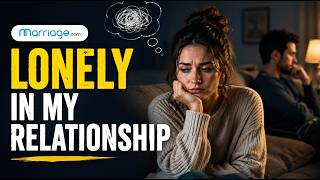
Watch the full Marriage.com video on falling out of love versus drifting apart, and then tell us in the comments: which side of this are you on right now? Someone watching this today needs to hear from someone who came out the other side.
Helpful?
Continue exploring this topic

Marriage.com AI: Your Relationship Guide
Talk through what's on your mind.
Automated
YOU COULD START WITH
Share this article on
Marriage.com Editorial Team
Relationship & Marriage Advice
The Marriage.com Editorial Team is a group of experienced relationship writers, experts, and mental health professionals. We provide practical and research-backed advice on relationships. Our content is thoroughly reviewed by experts... Read more to ensure that we offer high-quality and reliable relationship advice. Read less
 Reviewed by
Marriage.com Community
Real people. Real relationships. No judgment.
How do couples survive big life stress without turning on each other?
Have you navigated this in your own relationship?
Your perspective could help thousands of couples.
See what people are saying
Your perspective could help thousands of couples.










 We'd love your feedback!
 Thanks for your feedback!