




How Couples Handle Conflict: What the Data Shows

Reviewed By
Kristen Failla, LMFT
 Review Board Member
|
By
LMFT
Review Board MemberKristen is a Licensed Marriage and Family Therapist who provides mental health care for individuals, couples and families. She is particularly passionate about working with... Read More
Marriage.com Editorial Team

The Marriage.com Editorial Team is a group of experienced relationship writers, experts, and mental health professionals. We provide practical and research-backed advice on relationships. Our content is thoroughly reviewed by experts to ensure that we offer high-quality and reliable relationship advice.
Learn about Our Editorial Process
Updated: 27 Jul, 2026
Heal & Grow Daily for a Happier Relationship
Subscribe FREETable of Contents
View more
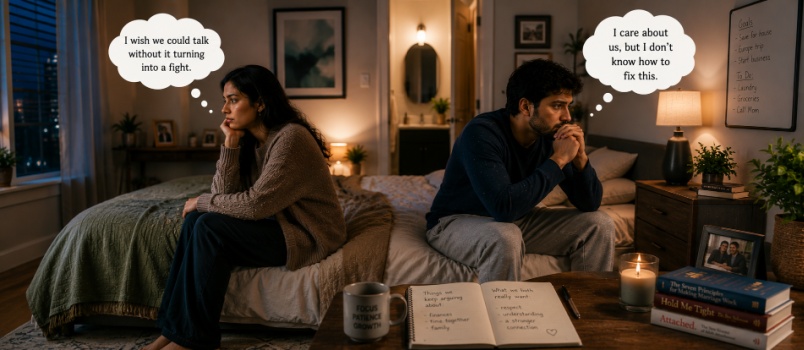
If you have ever walked away from an argument feeling like nothing was actually settled, you are far from alone. How couples handle conflict usually has less to do with how much they love each other and more to do with the patterns they slip into when tension rises.
Some talk it through.
Many go quiet.
A few keep score.
And for a striking number of couples, the same disagreement keeps coming back because it never truly ended.
According to Kristen Failla, LMFT, “Different communication styles, which may develop in early childhood, also influence the way in which couples navigate conflict. For example, individuals with people-pleasing tendencies and a fear of abandonment are likely to avoid conflict.
Other individuals with insecure attachment may prefer to address issues immediately. Resolving conflict effectively involves striking a balance between such behavioral styles.”
In a Marriage.com survey of 2,399 adults in committed relationships, only 22.9% said they usually work together to find a solution when they disagree. That means more than three in four couples reach for something other than teamwork when conflict shows up.

Below, we break down the four most common conflict-handling styles, show what the survey data reveals about how rare collaboration really is, explain why some issues never get resolved, and walk through research-backed ways to move toward problem-solving as a couple.
How do couples handle conflict?
Most couples handle conflict through avoidance or imbalance rather than collaboration. In the Marriage.com survey, only 22.9% of couples said they usually work together to find a solution. The rest fall into one of three less constructive patterns: one partner shuts down (36.5%), one partner typically gets their way (19.1%), or the issue is sidestepped altogether (13.1%).
Put another way, fewer than 1 in 4 couples treats a disagreement as a shared problem to solve. The other behaviors are not signs that a relationship is failing. They are common, human responses to feeling overwhelmed, unheard, or unsure how to begin. But they tend to leave the underlying issue untouched, which is how small frustrations quietly turn into recurring fights.
The four styles below offer a simple way to recognize your own pattern, and to see where it is heading.
What are the 4 conflict-handling styles?
The four most common conflict-handling styles are collaborating, accommodating, avoiding, and escalating. Each describes a different thing partners do when they hit a disagreement, and each leads to a different outcome for the issue itself.
Kristen Failla, LMFT, highlights that “The Thomas-Kilmann Conflict Mode Instrument (TKI), a relational assessment tool used to measure preferred and effective conflict resolution styles, poses five distinct types of communication, creatively ascribing them to animals as a means of personifying them; competitive (shark), avoidant (turtle), accommodating (teddy bear), compromising (fox) and collaborative (owl).”
- Collaborate: Both partners stay in the conversation and work toward a solution that accounts for both of their needs. This is the only style where the problem actually gets solved together. Just 22.9% of couples report doing this regularly.
- Accommodate: One partner gives in so the other gets their way. The argument ends quickly, but one person’s needs go unmet. About 19.1% of couples describe this pattern, where one partner typically “gets their way.”
- Avoid: One or both partners withdraw, go silent, or steer around the topic entirely. This is the single most common pattern in the data. More than a third (36.5%) say one partner shuts down, and another 13.1% sidestep the issue, so close to half of couples lean on some form of avoidance.
- Escalate: The disagreement intensifies into raised voices, blame, or personal attacks. Roughly 29% of respondents said conflicts sometimes escalate into insults or name-calling. Learning to fight fair keeps heated moments from tipping into this zone.
No one uses a single style all the time. Most couples move between them depending on the topic, the day, and how depleted they feel. The goal is not to label yourself permanently, but to notice which pattern you default to under stress.
A quick reference: the four styles at a glance
| Conflict style | What it looks like | What the survey found |
|---|---|---|
| Collaborate | Both partners stay engaged and solve the problem together | 22.9% usually work together to find a solution |
| Accommodate | One partner yields so the other gets their way | 19.1% say one partner typically gets their way |
| Avoid | Shutting down, going silent, or sidestepping the topic | 36.5% report one partner shuts down; 13.1% sidestep the issue |
| Escalate | Raised voices, blame, insults, recycled old arguments | 29% say conflicts sometimes escalate into insults |
Why is collaboration so rare for couples?
Collaboration is rare because the other three styles feel safer or easier in the moment, even though they cost more over time. Avoidance lowers tension right now. Accommodating ends the argument fast. Escalating at least releases the pressure. Collaboration, by contrast, asks both people to stay present, tolerate discomfort, and keep talking when every instinct says to retreat or push back.
The survey data makes the gap clear. With shutdown (36.5%) and sidestepping (13.1%) together accounting for close to half of couples, avoidance is the default, not the exception. This lines up with the broader finding that 70% of couples avoid at least one major relationship conversation entirely. When avoiding the conversation is already the norm, avoiding resolution inside the conversation follows naturally.
Avoidance and accommodation can look peaceful from the outside. A couple that rarely argues loudly may assume they are doing well. But conflict avoidance in relationships often hides unmet needs rather than resolving them, and those needs do not disappear. They wait. If shutting down is the pattern you recognize, our guide on how to respond to stonewalling offers concrete ways to reopen the conversation.
Why do some issues never get resolved?
Some issues never get resolved because avoidance and accommodation postpone the problem instead of solving it, so it resurfaces later. The survey found that only 16.5% of couples said their arguments are always resolved. Roughly 4 in 10 (40%) said old arguments often resurface during new fights, turning a fresh disagreement into a rerun of an older, unfinished one.
This is the quiet engine behind unresolved tension in relationships. When a disagreement ends because someone went silent or gave in, the issue is not closed. It is paused. The next time a related frustration comes up, the old one comes with it, often carrying more emotional weight than before. That is why a conversation that starts about dishes can suddenly be about respect, or why a small scheduling conflict reopens a months-old wound.
Recurring fights are rarely about the surface topic. They are usually about something that was never finished, and there are practical ways to break the cycle of recurring conflicts once you spot the pattern.
Avoidant versus collaborative conflict, side by side
| In an avoidant pattern | In a collaborative pattern |
|---|---|
| The conversation ends when someone withdraws or gives in | The conversation ends when both people understand the issue |
| The surface topic goes quiet, but the need stays unmet | The underlying need gets named and addressed |
| Relief is immediate but temporary | Resolution takes longer but tends to hold |
| The issue resurfaces in the next fight | The issue is far less likely to return |
| Distance builds slowly over time | Trust and closeness tend to grow |
How do conflict patterns differ by gender and relationship stage?
Conflict patterns differ modestly by gender and more noticeably by relationship stage. In the Marriage.com survey, women were slightly more likely to report shutdown behavior (38% versus 35% of men), while men were more likely to report that one partner gets their way (21% versus 17% of women). The dynamics differ, but the takeaway is the same: collaboration is less common than avoidance or imbalance for both.
Relationship stage tells a sharper story. Engaged couples stood out as the most likely to say arguments often end without resolution (26%), and the most likely to bring old fights into new ones (44%, compared with 38% of married couples). The engagement period often layers new pressure onto a relationship: merging finances, aligning on the future, and managing family expectations, all while the couple is still defining its conflict habits.
If you recognize your stage in these numbers, it helps to know that conflict patterns are learned, which means they can be relearned. These are not fixed traits. They are habits, and habits respond to attention.
What does research say about constructive conflict?
Research consistently separates constructive conflict, where partners stay engaged and work toward a solution, from destructive conflict, where they withdraw, escalate, or stonewall. The way a couple handles a disagreement tends to matter more for the relationship than the disagreement itself, and that pattern shows up clearly in long-term studies.
Tracking 373 married couples across the first 16 years of marriage, Birditt and colleagues, writing in the Journal of Marriage and Family, found that one mismatch was especially costly. When one partner tried to solve a problem with constructive behavior while the other responded by withdrawing or leaving the situation, the couple was more likely to divorce later on.
That is the survey’s single most common response, one partner shutting down at 36.5%, viewed over a much longer horizon. When withdrawal meets a partner who wants to engage, the unfinished issue does not simply linger. It can quietly wear the relationship down for years.
That dynamic has a name in the research: the demand-withdraw cycle, where one partner pushes to discuss an issue while the other pulls away, which tends to leave both people feeling unheard. Recognizing the cycle is the first step to interrupting it, because once both partners can name the pattern, neither has to take it as personally.
There is encouraging news about how changeable these patterns are.
In a 2024 study in the journal Personal Relationships, researchers found that a brief, structured reflection on a recent conflict lowered participants distress and increased their confidence in their ability to resolve relationship conflicts. The same work reinforced that simply avoiding conflict tends to backfire rather than protect the relationship.
In other words, it is not the presence of conflict that predicts trouble, but whether couples engage with it constructively.
How can couples shift toward collaboration?
Couples can shift toward collaboration by slowing the conversation down, naming the real issue, and treating the problem as shared rather than personal. None of this requires a perfect relationship or a conflict-free week. It requires small, repeatable changes to what you do in the first few minutes of a disagreement, when the pattern usually sets in.
Here are research-informed steps to practice problem solving as a couple:
- Name the pattern out loud. When you notice yourself shutting down or pushing harder, say so. “I think I’m starting to withdraw” gives both of you a chance to reset before the old cycle takes over.
- Lead with the need, not the complaint. Instead of “you never help,” try “I feel stretched thin and I need us to split this differently.” Naming the underlying need keeps the conversation on the actual problem.
- Agree to pause, not to quit. If you feel flooded, take a real break and set a time to return. A pause protects the conversation; walking away for good ends it unresolved. In the survey, 37% reported feeling overwhelmed during conflict, so this is common.
- Take one issue at a time. When an old argument tries to climb into the current one, gently set it aside for now. You can only solve the problem in front of you.
- Close the loop. Before the conversation ends, say what you each agreed to, even if it is just “we will revisit this on Sunday.” Closure is what separates a resolved issue from a postponed one.
For couples who want structured guidance and practice, Marriage.com’s relationship courses walk through communication and conflict skills step by step, and our guide to building better communication habits covers the day-to-day skills behind these steps.
If conflicts feel stuck, frequent, or painful, working with a professional can help. You can find a therapist who specializes in couples communication. Therapy is a proactive step toward a healthier relationship, not a last resort.
Frequently asked questions
Is conflict avoidance bad for a relationship?
Conflict avoidance is not harmful in every moment, but as a default pattern it tends to wear on a relationship over time. Avoiding a difficult conversation can lower tension briefly, yet it usually leaves the underlying need unmet. Those unmet needs often resurface later, which is why avoidant couples frequently report the same arguments returning.
Why do the same arguments keep coming back?
The same arguments keep coming back because they were postponed, not resolved. When a disagreement ends through withdrawal or giving in, the issue is paused rather than closed. In the survey, 40% of couples said old arguments often resurface during new fights, carrying extra emotional weight each time.
What are healthy relationship conflict patterns?
Healthy relationship conflict patterns center on staying engaged, naming the real issue, and solving it together. This collaborative style is associated with stronger long-term satisfaction in relationship research. The aim is not to avoid conflict but to handle it as a shared problem rather than a contest.
How can we get better at problem solving as a couple?
You can get better at problem solving as a couple by slowing down, leading with the underlying need, pausing instead of quitting when overwhelmed, and closing each conversation with a clear agreement. Structured courses or couples therapy can help you practice these skills, especially if conflicts feel stuck or keep repeating.
The pattern matters more than the fight
How you handle conflict shapes your relationship far more than how often you disagree. The Marriage.com survey makes that plain: most couples are not failing to love each other, they are falling into avoidance, accommodation, or escalation when teamwork feels too hard in the moment. Only 22.9% regularly collaborate, and unresolved issues have a way of returning until they are addressed.
The encouraging part is that conflict styles are learnable. Naming your pattern, leading with the need beneath the complaint, and closing each conversation with real resolution are skills any couple can build. The issues that never get resolved are usually the ones that were never finished, and finishing them, one conversation at a time, is within reach.
For more guidance, explore Marriage.com’s relationship courses for happier relationships.
Methodology
The statistics in this article come from a Marriage.com survey of 2,399 U.S. adults in committed relationships (dating, engaged, cohabiting, or married), conducted in August 2025. Respondents were balanced across age groups, genders, and U.S. regions. Data was collected anonymously through an online questionnaire. Margin of error: plus or minus 2% at a 95% confidence level.
Helpful?
Continue exploring this topic

Marriage.com AI: Your Relationship Guide
Talk through what's on your mind.
Automated
YOU COULD START WITH
Share this article on
Marriage.com Editorial Team
Relationship & Marriage Advice
The Marriage.com Editorial Team is a group of experienced relationship writers, experts, and mental health professionals. We provide practical and research-backed advice on relationships. Our content is thoroughly reviewed by experts... Read more to ensure that we offer high-quality and reliable relationship advice. Read less


Recent Articles



Related Quizzes




 We'd love your feedback!
 Thanks for your feedback!