




11 Examples of Traditional Gender Roles and Their Impact

By
Anne Duvaux
, Coach
, Coach
Anne’s passion and purpose in life are to guide people to find their own path and contentment by learning about themselves. Only then can we build and nurture the deep... Read more
Learn about Our Editorial Process
17.6k Reads
Updated: 15 Jan, 2026
Heal & Grow Daily for a Happier Relationship
Subscribe FREETable of Contents
View more
Key Takeaways
From childhood expectations to workplace norms, gender roles often slip into daily life so quietly that they feel “normal.” Some were shaped by history, others by culture or survival needs… yet their effects still echo today.
While a few may offer structure or familiarity, many create pressure, limit choices, or leave people feeling unseen. These examples of traditional gender roles can influence confidence, relationships, careers, and even self-worth, often without anyone meaning harm.
Recognizing their impact doesn’t require blame or conflict; it simply opens space for understanding. After all, roles meant to guide us shouldn’t confine us, silence us, or make us feel smaller than we are… and many are gently being questioned, rethought, and reshaped.
What are traditional gender roles in a relationship?
Traditional gender roles in a relationship are socially learned expectations about how partners “should” behave based on gender.
Life Coach Jaclyn Hunt points out,
Relationships do not need defined roles. You simply need to contribute the same amount of love and energy into that relationship.
They often assume one partner leads, earns, or makes decisions, while the other nurtures, supports, or manages the home.
A research paper published in 2019 states that couples with more flexible gender-role beliefs share household work more fairly, which is linked to higher marital satisfaction and healthier relationship dynamics.
These roles can shape communication, emotional expression, finances, and power dynamics, sometimes without either partner consciously choosing them.
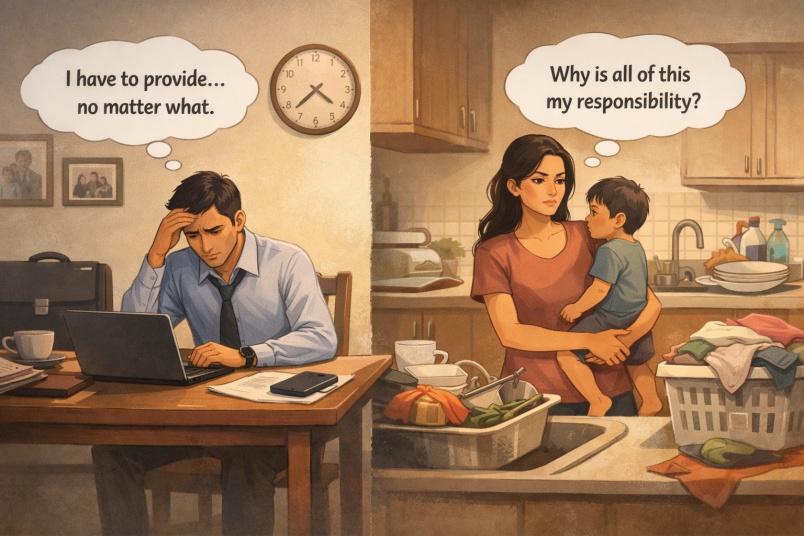
Example: A couple might assume the man should avoid showing vulnerability while the woman should handle emotional care. Over time, this can leave one partner feeling pressured to “stay strong” and the other feeling overburdened, which is one of many examples of traditional gender roles showing up in everyday relationships.
Please note:
If these patterns sound familiar, it’s okay. Many couples navigate them unintentionally. Awareness creates room for gentler conversations, shared choices, and roles that actually fit both partners, not outdated expectations.
11 types of traditional gender roles
Traditional gender roles examples are varied and range from behavioral to occupational and personality differences.
Life Coach Jaclyn Hunt further points out,
The masculine or feminine role is outdated. Teamwork makes the dreamwork.
Society then tends to reward compliance and ostracize those who try to be themselves.
1. Men earn money
Traditional husband and wife roles are usually split between the male breadwinner and the female housewife.
A research paper published in the Frontiers in Psychology states that rigid gender roles increase stress and reduce well-being, while flexible roles support healthier relationships, emotional balance, and life satisfaction.
This originally came from agricultural influences, where muscle and strength were needed to work the tools.
- How it impacts: Men may feel constant financial pressure, while women may feel dependent or undervalued, even when both partners want shared responsibility.
2. Women cook at home

Traditional gender roles in marriage usually mean that women do the cooking, cleaning, and food shopping. They are assumed to be naturally drawn towards cooking and better suited for this responsibility.
The gender roles are based on the traditional notion that women are more proficient at most matters related to taking care of the household. Interestingly, men still dominate the chef profession in the food industry.
- How it impacts: Women may feel overworked or unappreciated, while men may miss chances to contribute or bond through shared household tasks.
3. Chivalrous men
Traditional relationship roles include the man protecting the woman. That can be anything from carrying things for her to opening doors. You might also see men walking on the roadside to protect women from cars.
The notion that “men don’t cry” is based on the notion that men are chivalrous and stronger than women, both physically and mentally. Thus, they are seen as the protectors and caretakers of women.
- How it impacts: Men may suppress emotions, leading to stress or isolation, while women may feel perceived as less capable or independent.
4. Job selection
Nontraditional gender roles are when women become engineers and men join the teaching profession, for instance. Sadly, women are still paid less than men for the same jobs.
- How it impacts: Career choices may feel limited, and pay inequality can affect confidence, motivation, and long-term financial security.
5. Behavioral norms
Traditional relationship roles also include behaviors. So, many families assume that men are more intelligent and push their sons into further education. On the other hand, women learn that they should focus on finding a husband.
Both male and female brains are plastic and can adjust and learn as much or as little as the individual chooses.
- How it impacts: These expectations can limit ambition, reinforce self-doubt, and prevent individuals from reaching their full potential.
6. Nurture versus discipline
Traditional relationship rules state that women are the caring ones who show emotions. Women become the primary nurturers at home because men are the tough ones who do the discipline.
- How it impacts: Women may experience emotional burnout, while men may feel disconnected from caregiving and emotional bonding with children.
7. Clothing style
It’s helpful to consider fashion when wondering, “What are traditional gender roles.” How many girls’ baby clothes are pink while boys’ clothes are blue? Even in the workplace, many assume that women wear skirts and men wear trousers.
- How it impacts: People may feel judged or restricted when expressing personal style outside traditional expectations.
8. Children’s toys
The list of female gender roles includes how we play as children. Society expects boys to play with cars and make Meccano train sets while girls play with dolls. This further adds to the pressure that boys are tough and don’t cry, but girls are free to express their emotions.
- How it impacts: Children may feel pressured to hide interests, limiting creativity, emotional development, and confidence.
9. Housewife
Traditional gender roles in relationships mean women stay home and look after the house. The word househusband isn’t in everyday use. However, the proportion of men who take on this role is perhaps increasing, as this study suggests.
- How it impacts: Women may lose financial independence, while men may face stigma for choosing caregiving roles.
10. Hobby expectations
Traditional male roles in society also involve the type of hobbies people take on. For instance, men go and play golf or football, whereas women join knitting groups. Of course, this isn’t so much the case in Western societies anymore, but there are still some lingering beliefs.
- How it impacts: People may avoid hobbies they genuinely enjoy due to fear of judgment or social pressure.
11. Personality
Gender roles examples also cover personality. The same traits in men and women are not described in the same way. So, men are confident and persuasive, but women are bossy and pushy, to quote some examples.
- How it impacts: This double standard can discourage women from leadership roles and affect their self-esteem and assertiveness.
How to challenge traditional gender roles?
Challenging examples of traditional gender roles begin with awareness, curiosity, and compassion.
Life Coach Jaclyn Hunt points out,
Relationships do not need defined roles. You simply need to contribute the same amount of love and energy into that relationship.
Small, everyday choices can quietly reshape expectations, create balance, and allow people to live more authentically, without pressure to fit outdated molds.
- Question assumptions about who should do what, at home or work
- Share responsibilities based on strengths, not gender
- Encourage emotional expression in everyone, without judgment
- Support diverse career paths and interests equally
- Model flexibility and respect in relationships and families
5 drawbacks of traditional gender roles
Traditional gender roles may seem familiar or even comforting at first, but they often come with hidden costs.
Looking at the overall picture, Life Coach Jaclyn Hunt concludes,
Defining your role in a relationship is much like defining your role at work. If you both complement each other and put the same amount of work and effort into that relationship, the role definition does not matter.
These expectations can quietly limit choices, shape self-belief, and affect relationships, careers, and emotional well-being. Over time, what starts as “normal” can become restrictive, not just for individuals, but for families and society as a whole.
1. Limits personal freedom early
Traditional gender roles often shape beliefs from childhood. Girls may be taught they need protection or should aim smaller, while boys feel pressure to be strong and self-reliant. These early messages quietly limit curiosity, confidence, and long-term opportunities.
- Try doing: Encourage children and adults alike to explore interests without labeling them “for boys” or “for girls.”
2. Reinforces harmful language and labels
Every day, language often praises men for being assertive while criticizing women for the same behavior. Over time, this reinforces passivity in women and emotional restraint in men, shaping how people see themselves and others.
- Try doing: Notice and challenge gendered labels
3. Damages self-esteem and emotional expression
Fixed roles push people to suppress parts of themselves to fit expectations. Women may hide ambition or anger, while men may avoid vulnerability, which can weaken self-worth and emotional connection over time.
- Try doing: Create space for open expression without judging emotions or traits as gendered.
- like “bossy” or “too emotional” when they appear.
RELATED READING : 9 Reasons Why Self-Esteem Can Be Important for Relationships
4. Strains relationships and family bonds
When men are expected to prioritize work, and women are caregivers, family relationships can suffer. Fathers may miss meaningful time with children, and mothers may feel overburdened or unseen.
- Try doing: Share caregiving, household, and emotional labor more intentionally and openly.
Watch this TED Talk by Michael Kimmel, a sociologist, who shares how gender equality benefits by improving relationships, emotional health, and overall social well-being.

5. Holds back society and economic growth
Restrictive gender roles limit who enters certain professions, reducing diversity and innovation. Research shows closing gender gaps boosts productivity, GDP, and overall well-being, benefiting everyone.
- Try doing: Support equal opportunities in education, leadership, and caregiving roles across genders.
FAQ
Examples of traditional gender roles have long shaped our societies, influencing expectations and behaviors for individuals based on their gender. So, having questions about these roles is apparent. Below, we have answered some commonly asked questions about traditional gender roles.
- What are the benefits of traditional gender roles?
The benefits of traditional gender roles lie in their stability and predictability in families and communities. Roles can help establish clear expectations and responsibilities, encouraging teamwork and efficient division of labor.
- How do gender roles affect relationships?
Gender roles can significantly affect relationships by shaping communication patterns, decision-making processes, and emotional expression. They can create a sense of security or lead to conflicts if one feels restricted or limited by societal norms.
- Are traditional gender roles still prevalent in today’s society?
While traditional gender roles have become more fluid and evolved, they still hold some prevalence. Although progress has been made toward more egalitarian societies, remnants of traditional gender roles can still be observed in certain cultural, social, and workplace settings.
Moving forward
Examples of traditional gender roles show how deeply expectations can shape lives, often without conscious choice. While some roles once served a purpose, many now limit growth, connection, and self-expression. Questioning them isn’t about blame or rejection of tradition; it’s about creating space for fairness, flexibility, and authenticity.
When individuals feel free to choose roles that suit their strengths and values, relationships become healthier, workplaces more innovative, and families more balanced. Small shifts in mindset can lead to meaningful change, allowing everyone to live with greater confidence, dignity, and emotional well-being.
Helpful?
Continue exploring this topic

Marriage.com AI: Your Relationship Guide
Talk through what's on your mind.
Automated
YOU COULD START WITH
Share this article on
Anne Duvaux
Coach
 Reviewed by
Marriage.com Community
Real people. Real relationships. No judgment.
How do couples survive big life stress without turning on each other?
Have you navigated this in your own relationship?
Your perspective could help thousands of couples.
See what people are saying
Your perspective could help thousands of couples.
Related Articles


Recent Articles

Related Quizzes







 We'd love your feedback!
 Thanks for your feedback!