




How to Know If You Are Bisexual: 11 Signs to Consider

Reviewed By
Danica Mitchell, Sex Therapist
 Review Board Member
|
By
Sex Therapist
Review Board MemberDanica is dedicated to helping couples and individuals in NY & NJ, navigate complex aspects of their relationships. Her approach is grounded in Cognitive Behavioral Therapy,... Read More
Dylan Banks, Author

Dylan Banks offers sharp insights on relationships, love, and human connection. A leading expert, he's passionate about helping others build meaningful connections.
Learn about Our Editorial Process
100 Reads
Updated: 15 Jun, 2026
Heal & Grow Daily for a Happier Relationship
Subscribe FREETable of Contents
View more
Key Takeaways
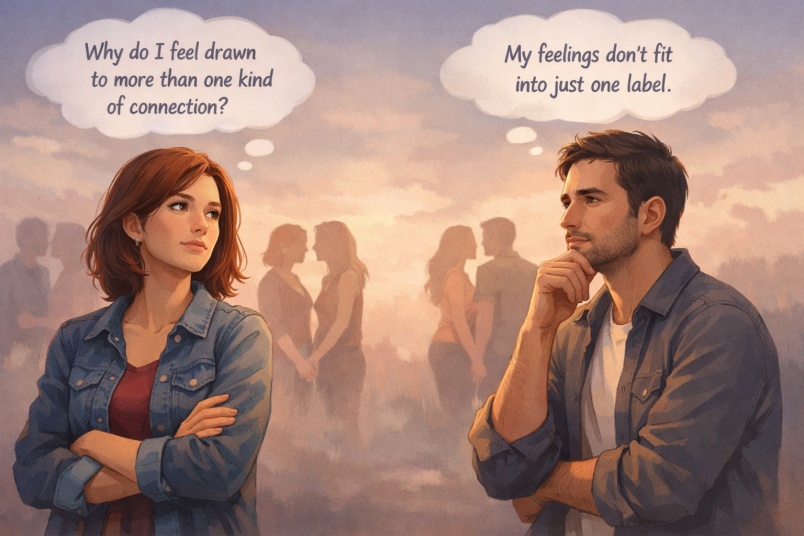
Wondering how to know if you are bisexual is more common than most people realize. Attraction does not always arrive with a clear label attached. Sometimes it shows up as a surprising crush, a quiet emotional pull toward someone unexpected, or a recurring sense that the categories you have been offered do not quite fit.
That uncertainty is not a problem to solve. It is simply a sign that you are paying attention to yourself honestly.
You do not need to have all the answers today. There is no deadline on understanding your own attraction, and there is no single experience that makes your feelings more or less real.
What does it mean to be bisexual?
Being bisexual means experiencing romantic and/or sexual attraction to more than one gender. It doesn’t have to be equal, constant, or acted upon—attraction can shift over time and still be valid. The bisexual meaning is about how you feel inside, not about labels, relationship history, or who you’re currently with.
A research paper published in the American Psychological Association states that bisexuality is a normal and valid sexual orientation, involving attraction to more than one gender, and exists on a spectrum rather than being fixed or abnormal.
Example: Someone might feel emotionally drawn to people of different genders, even if they’ve only dated one. They may notice recurring attractions, curiosity, or connections that don’t fit a single category, often aligning with common signs you are bisexual.
Please note:
If this resonates, take your time. There’s no rush to label yourself or explain it to anyone. Questioning is normal, and whatever you discover about yourself is valid, personal, and deserving of kindness.
How To Know If You Are Bisexual: 11 Possible Signs
Bisexuality can show up in subtle, deeply personal ways. For some, it’s emotional closeness; for others, attraction that doesn’t follow one pattern. These bisexuality signs in women and bisexuality signs in men often overlap, reflecting how fluid and individual attraction can truly be.
How to know if you are bisexual? Here are some possible signs you are bisexual that might suggest a bisexual orientation. By going through these signs, you might be able to understand how to tell if a man or woman is bisexual.
1. Attraction to multiple genders
A fundamental answer to how to know if you are bisexual is feeling attracted to people of more than one gender. This attraction can be emotional, romantic, or sexual.
It doesn’t necessarily have to be equally distributed among all genders; the key aspect is the capacity to find more than one gender appealing in some way.
2. Fantasizing about different genders
If you find yourself fantasizing about romantic or sexual experiences with people of various genders, it could be a sign of bisexuality. These fantasies are a reflection of your inner desires and can indicate a broader spectrum of attraction than previously acknowledged.
3. Crushes on multiple genders
Developing crushes on individuals of different genders is a common experience among bisexual individuals. These crushes, whether they are deep and emotional or more superficial, suggest an openness and attraction to more than one gender.
4. Feeling a sense of resonance with LGBTQ+ stories
You may feel a quiet sense of familiarity or emotional connection when engaging with LGBTQ+ stories or characters. This resonance can sometimes reflect personal feelings or questions about attraction, though it can also come from empathy, curiosity, or shared human experiences.
5. Questioning your orientation

Regularly questioning your sexual orientation or feeling that you don’t neatly fit into the categories of “straight” or “gay” can be a sign of bisexuality.
A research paper published in the International Journal of Environmental Research and Public Health states that people questioning their sexual identity often experience confusion and self-exploration, which is normal and linked to ongoing personal growth and understanding.
This questioning is often a part of the journey toward understanding your own sexual identity.
6. Fluidity in attractions
Experiencing fluidity in your attractions where the genders you find appealing shift over time is a common characteristic of bisexuality. Rather than seeing this as an inconsistency, many bisexual people describe it as one of the most honest expressions of how their attraction actually works.
7. Relatability to bisexual characters
Finding a connection or relatability to bisexual characters in literature, film, or television can become a meaningful part of self-discovery sexuality.
These characters might resonate with you because they reflect feelings, experiences, or questions similar to your own. Seeing diverse identities represented can help you better understand your emotions, explore your attractions, and feel more connected to your own journey.
8. History of different gender relationships
How to know if you are bisexual? Having a history of dating or being attracted to people of various genders could indicate bisexuality. This pattern might suggest that your attraction is not limited to a single gender, and you prefer exploring when it comes to your dating or romantic life.
9. Rejection of binary labels
Feeling uncomfortable or restricted by labels such as “gay” or “straight” might mean that you fall somewhere in the middle, such as being bisexual. This discomfort can arise from a feeling that these labels don’t fully capture the complexity of your attractions.
10. Romantic vs. sexual attraction variances
If you experience romantic attraction differently from sexual attraction, particularly across different genders, that distinction is worth noticing. Many people find that their emotional and physical attractions do not always point in the same direction, and bisexuality can accommodate that complexity without requiring an explanation.
11. Openness to multiple genders
Simply being open to the possibility of being romantically or sexually involved with someone of any gender can be a sign of bisexuality. This openness is a broad, inclusive approach to attraction and relationships, characteristic of a bisexual orientation.
How to Accept Being Bisexual: 5 Practical Steps
How to know if you are bisexual? Accepting your bisexuality is a significant step in embracing your true self. This process can be complex and filled with a range of emotions and thoughts.
It’s about understanding attraction and feelings toward more than one gender. Here are some key points to consider in your journey toward acceptance:
- Self-reflection: Spend time introspectively considering your feelings and attractions. Acknowledge these feelings as a natural part of who you are. Understanding yourself is the first step in acceptance.
- Education: Learn about bisexuality from reliable sources. Understanding the spectrum of sexual orientations can help normalize your experiences and feelings.
- Connecting with the LGBTQ+ community: Engage with the LGBTQ+ community, either online or in person. Being around others who have gone through similar experiences can provide comfort and understanding.
- Open conversations: If you feel safe, discuss your feelings with trusted friends or family members. Open dialogue can provide support and help dispel feelings of isolation.
- Professional support: Consider speaking with a therapist, especially one who specializes in LGBTQ+ issues. They can offer guidance and a non-judgmental space to explore your feelings.
9 Common Misconceptions About Bisexuality (and the Reality)
Bisexuality, often misunderstood and surrounded by stereotypes, faces numerous misconceptions. These misunderstandings can lead to stigma and make it harder for bisexual individuals to embrace and express their identity openly.
A study published in 2020 states that bisexual people often face identity invalidation from others, which can negatively affect their mental health, relationships, and sense of self-acceptance.
Addressing these misconceptions is crucial for promoting a more inclusive and understanding society. Here are nine common misconceptions about bisexuality, each explained to provide clarity:
1. Bisexuality is a phase
A prevalent misconception is that bisexuality is merely a transitional phase before settling as either straight or gay. This belief undermines the validity of bisexuality as a legitimate and enduring sexual orientation.
Sex therapist Danica Mitchell adds, it is okay to explore different labels and shift your understanding over time. For some, bisexuality is part of a journey of exploration; for others, it’s a clear and enduring identity. Both experiences are valid.
Bisexual individuals experience consistent and genuine attraction to more than one gender, regardless of their current relationship status or sexual history.
- But the reality is: Bisexuality can be a lasting identity, even if someone’s self-understanding evolves over time.
2. Bisexuals are promiscuous
The stereotype that bisexual people are more promiscuous than others is unfounded and harmful. Signs you are bisexual are about the capacity for attraction to more than one gender, not about the number of partners one has. Like anyone else, bisexual people have diverse approaches to relationships and sexual activity.
- But the reality is: Sexual behavior varies by individual values and choices, not by sexual orientation.
3. Bisexuality equals polyamory
Some people wrongly assume that being bisexual automatically means being polyamorous. While some bisexuals may choose polyamory, bisexuality itself is solely about the genders one is attracted to and does not dictate relationship styles or preferences.
- But the reality is: Bisexual people can prefer monogamy, polyamory, or any relationship style, just like anyone else.
RELATED READING : How Attachment Styles Affect Relationships
4. Bisexuals are confused
The idea that bisexual individuals are just confused about their sexual orientation is a common myth. Bisexuality is a clear and valid identity. Like anyone, bisexual people might explore their sexuality, but this exploration is not a sign of confusion but of understanding oneself.
- But the reality is: Self-exploration reflects self-awareness, not uncertainty or indecision.
RELATED READING : 10 Ways to Practice Self-Awareness in Relationships
5. Bisexuality requires equal attraction
Another misconception is that bisexuals must be equally attracted to men and women. Bisexuality allows for varying degrees and types of attraction to different genders. The balance of these attractions can also shift over time.
- But the reality is: Bisexual attraction doesn’t have to be equal, fixed, or constant to be valid.
6. Bisexuals are more likely to cheat
The myth that bisexual people are inherently unfaithful in relationships is unfounded and perpetuates harmful stereotypes. Sexual orientation, including bisexuality, does not determine one’s propensity for fidelity in relationships.
- But the reality is: Cheating is about personal boundaries and choices, not sexual orientation.
7. Invisible in a heterosexual relationship
Bisexual individuals in opposite-sex relationships are often incorrectly assumed to be straight. This erasure of their bisexual identity questions overlooks the complexity of their attractions and the importance of their identity, regardless of their partner’s gender.
- But the reality is: A person’s current relationship does not erase or redefine their bisexual identity.
Watch this TED Talk featuring Misty Gedlinske, founder of Fond du Lac Pride Alliance. She discusses the stigma surrounding bisexuality and public perceptions of it:

8. Bisexuality doesn’t exist in men
There is a false belief that bisexuality is exclusive to women, and men who claim to be bisexual are either gay or in denial. This erases the experiences of countless bisexual men and invalidates their identity. Just like in females, bisexuality in males exists.
- But the reality is: Bisexual men are real, valid, and deserving of the same recognition and respect.
9. Can’t be monogamous
The ability to be in a committed, monogamous relationship is independent of one’s sexual orientation. Bisexual people, like individuals of any other orientation, can and do engage in monogamous relationships based on personal preference, not their bisexuality.
- But the reality is: Commitment is shaped by values and agreements, not by attraction to more than one gender.
FAQs
Navigating questions about signs you are bisexual can be crucial for understanding and acceptance. Here are answers to some frequently asked questions:
How do you know if you are a bisexual woman?
For many women, recognizing bisexual attraction involves noticing emotional and romantic pulls toward other women alongside attraction to men, even if those feelings have never been acted on. The experience can feel subtle at first, arriving as admiration that shades into something more, or a curiosity that keeps returning despite being set aside.
Is bisexuality a phase?
Bisexuality is not a phase. It is a recognized and valid sexual orientation sign that can remain stable across a person's lifetime, even as the intensity or focus of their attraction naturally shifts over time.
For some people, bisexuality is the endpoint of their self-exploration; for others, it is a word they eventually trade for a different one. Both experiences are real.
The idea that bisexuality is transitional often comes from outside pressure rather than from bisexual people's own experience of their identity. What matters is how you experience attraction over time, not whether your identity fits a timeline that makes others more comfortable.
Can you be bisexual if you have only dated one gender?
Yes. Bisexuality is defined by the capacity for attraction to more than one gender, not by relationship history. Many bisexual people have only ever dated one gender, whether by circumstance, personal preference, or because they came to understand their identity later in life. The absence of a particular relationship does not erase a genuinely felt attraction.
How do I know if I am bisexual or just curious?
Curiosity and bisexuality are not opposites, and the line between them does not need to be resolved before your feelings are worth taking seriously. Curiosity about people of more than one gender, when it is recurring and genuine, is often how bisexual attraction first makes itself known.
Waiting until you are certain before allowing yourself to explore is rarely how self-understanding actually works.
What is the difference between bisexuality and pansexuality?
Bisexuality refers to attraction to more than one gender, while pansexuality refers to attraction to people regardless of gender, sometimes described as attraction where gender plays little or no role in the experience.
In practice, many people use the two terms interchangeably, and some identify with both at different points in their lives.
Honoring yourself
Wondering how to know if you are bisexual is more common than most people realize. Attraction does not always arrive with a clear label attached.
Danica further adds, it is important to accept and love yourself for who you are and to find a community that loves you for you.
Sometimes it shows up as a surprising crush, a quiet emotional pull toward someone unexpected, or a recurring sense that the categories you have been offered do not quite fit.
That uncertainty is not a problem to solve. It is simply a sign that you are paying attention to yourself honestly.
You do not need to have all the answers today. There is no deadline on understanding your own attraction, and there is no single experience that makes your feelings more or less real.
Helpful?
Continue exploring this topic

Marriage.com AI: Your Relationship Guide
Talk through what's on your mind.
Automated
YOU COULD START WITH
Share this article on
Dylan Banks
Author
Dylan Banks is a prolific writer, known for his sharp and insightful commentary on relationships, love, and human connection. With his extensive experience and infectious passion for all things love-related, he has become a leading... Read more expert in the field of relationship advice. Dylan is a true romantic at heart, with a deep passion for helping others find love and build meaningful connections. When he’s not writing about love and relationships, Dylan can be found exploring the great outdoors or indulging in his other passion: music. As an accomplished musician and songwriter, he believes that music has the power to connect people in profound ways. Read less

Marriage.com Community
Real people. Real relationships. No judgment.
How do you deal with family being “polite but distant” about your LGBTQ+ relationship?
Have you navigated this in your own relationship?
Your perspective could help thousands of couples.
See what people are saying
Your perspective could help thousands of couples.


Recent Articles



Related Quizzes



Recent Videos
View all


Join millions building healthier, happier relationships.


 We'd love your feedback!
 Thanks for your feedback!