




How Couples Handle Conflict: 4 Styles, Based on Survey Data

By
Marriage.com Editorial Team
The Marriage.com Editorial Team is a group of experienced relationship writers, experts, and mental health professionals. We provide practical and research-backed advice on relationships. Our content is thoroughly reviewed by experts to ensure that we offer high-quality and reliable relationship advice.
Learn about Our Editorial Process
Updated: 15 Jul, 2026
Heal & Grow Daily for a Happier Relationship
Subscribe FREETable of Contents
View more
If your arguments seem to end without ever really ending, you are picking up on something real. In a Marriage.com survey of 2,399 U.S. adults in committed relationships, only 22.9% said they usually work together to find a solution when a disagreement comes up. Everyone else defaults to some version of shutting down, giving in, or letting the issue slide, and none of those patterns actually resolve what started the fight.
This isn’t about who is right in an argument. It’s about what happens once the disagreement starts, and why so many couples end up circling back to the same fight weeks or months later.
How do couples typically handle conflict?
Most couples fall into one of four recognizable patterns when a disagreement starts: collaborating, accommodating, avoiding, or escalating. According to the same survey, collaboration, actually working together toward a solution, is the least common of the four, reported by fewer than 1 in 4 couples.

Here’s what the other three look like in the data:
- 36.5% say one partner shuts down or refuses to talk (avoidance)
- 19.1% say one partner typically “gets their way” (accommodation, usually one-sided)
- 13.1% say the issue just gets sidestepped altogether (avoidance, softer form)
- 22.9% say they work together to find a solution (collaboration)
- 8.4% say that they rarely disagree
The 4 main conflict-handling styles
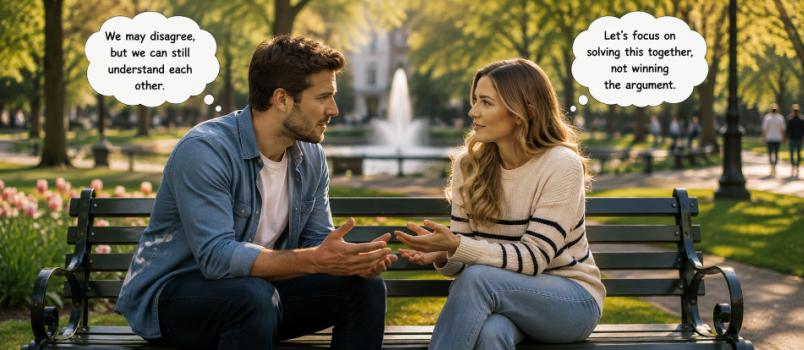
- Collaborating. Both partners stay engaged, name what they each need, and look for a solution together. This is the style most closely linked to conflicts actually staying resolved, and it’s also the rarest.
- Accommodating. One partner concedes, often to end the discomfort of the disagreement rather than because they’ve been persuaded. It can look peaceful in the moment. Over time, it tends to build quiet resentment, since the underlying issue was never actually addressed.
- Avoiding. One partner withdraws, shuts down, or the couple simply moves on without discussing the issue. This is the single most common response in the data. It feels like the conflict is over, but the disagreement hasn’t been resolved so much as postponed.
- Escalating. The disagreement grows louder or more personal instead of resolving. This shows up less in how couples describe their general pattern and more in what happens inside a specific fight, when things spill past the original issue.
Why collaboration is the exception, not the rule
Collaboration takes something the other three styles don’t: both partners tolerating the discomfort of staying in the disagreement long enough to work through it. Shutting down, giving in, or changing the subject all end the discomfort faster, which is exactly why they’re more common, even though they don’t address the actual issue.
Does conflict-handling style differ by gender or relationship stage?
Yes, though the differences are modest rather than dramatic. Women were slightly more likely to report shutdown behavior (38% vs. 35% of men), while men were somewhat more likely to report one partner “getting their way” (21% vs. 17% of women). The overall pattern, avoidance and imbalance outpacing collaboration, held for both genders.
Relationship stage matters too. Engaged couples were more likely than married or dating couples to report that arguments often end without resolution, a stage that tends to carry extra pressure around commitment and future planning, which may make it harder to stay in a disagreement long enough to resolve it together.
Why do unresolved conflicts keep coming back?
Because the underlying issue was never actually addressed, just paused. 4 in 10 couples (40%) say old arguments resurface during new fights, turning a disagreement about tonight’s dishes into a rehash of last month’s vacation planning fight, or worse.
This is the mechanism behind why avoidance and accommodation feel like they “work” short-term but accumulate cost over time. Every sidestepped issue is still sitting there, waiting for the next disagreement to reactivate it.
Comparison: Collaborative vs. avoidant conflict handling
| Collaborative style | Avoidant style | |
|---|---|---|
| What happens in the moment | Both partners stay engaged and work toward a solution together | One partner withdraws, shuts down, or the topic gets dropped |
| How common it is | 22.9% of couples | 36.5% shut down + 13.1% sidestep the issue |
| Immediate feeling | Can feel effortful or uncomfortable | Can feel like relief or de-escalation |
| What happens to the underlying issue | Addressed directly | Left unresolved, often resurfaces later |
| Long-term pattern | Builds a track record of resolving disagreements together | Can build quiet distance or resentment over time |
How can couples shift toward more collaborative conflict handling?
A few things reliably help, even for couples who default to shutdown or avoidance:
- Naming the pattern out loud. Simply saying “I think we’re avoiding this again” interrupts the automatic pull toward shutting down.
- Separating the timing from the topic. Many couples avoid conflict not because the topic is impossible, but because the moment feels wrong. Agreeing on a specific time to return to it (not “never,” not “right now”) keeps the issue from just disappearing.
- Starting smaller. Couples who rarely collaborate don’t need to solve their biggest recurring issue first. Practicing collaboration on a lower-stakes disagreement builds the pattern before it’s tested under real pressure.
- Getting outside support when the pattern feels stuck. If avoidance or one-sided accommodation has become the default for years, not weeks, working with a licensed therapist can help both partners build the collaboration skill together rather than one partner carrying it alone.
If this pattern sounds familiar in your own relationship, our communication course walks through practical ways to stay engaged during disagreements, or you can find a therapist who specializes in couples’ conflict work.
FAQ
Why do some couples never resolve their arguments?
Many couples default to avoidance or one-sided accommodation because both feel faster and less uncomfortable in the moment than working through a disagreement together. The tradeoff is that the underlying issue stays unresolved. Roughly 4 in 10 couples report that old arguments resurface during new fights, which is often a sign the original issue was postponed rather than settled.
Is it normal for one partner to shut down during an argument?
It's common. Over a third of couples surveyed said one partner shuts down or refuses to talk during disagreements, making it the single most reported conflict pattern. Common doesn't mean harmless, though. Shutting down repeatedly can leave the underlying issue unaddressed and, over time, create distance between partners.
Does conflict-handling style change by relationship stage?
Somewhat. Engaged couples were more likely than married or dating couples to report that arguments often end without resolution, a stage that often comes with added pressure around commitment and future planning. Gender differences were modest: women reported shutdown behavior slightly more often, men reported one partner "getting their way" slightly more often.
Can couples change their conflict-handling pattern?
Yes. Conflict style is a pattern, not a fixed trait, and patterns can shift with practice. Naming the avoidance out loud, agreeing on a specific time to return to a postponed topic, and practicing collaboration on lower-stakes disagreements first are all practical starting points. For patterns that feel stuck, working with a licensed couples therapist can help.
What's the difference between avoiding conflict and giving your partner space?
Taking a short pause to cool down before returning to a disagreement is different from avoidance, as long as the couple actually returns to the topic. Avoidance, in the pattern this survey measured, refers to the issue never actually getting addressed, either because one partner shuts down or because the couple quietly drops it.
The pattern matters more than the fight itself
None of the four conflict styles make a couple broken. Shutting down, giving in, or letting an issue slide are all understandable ways to get through a hard moment, and most people learned them long before this relationship. But the data is fairly clear on what happens next: patterns that end the discomfort quickly also tend to leave the actual issue in place, which is why it comes back.
Collaboration isn’t the only “correct” style, but it’s the one most consistently tied to conflicts actually staying resolved, and it’s a skill that can be built rather than a trait some couples simply have. Noticing which pattern you and your partner default to is usually the first real step toward changing it.
If a specific unresolved issue keeps resurfacing in your relationship, or if shutdown and avoidance have become the default for years rather than the occasional rough week, working through it with a licensed therapist can help both partners build a more collaborative pattern together.
Helpful?
Share this article on
Marriage.com Editorial Team
Relationship & Marriage Advice
The Marriage.com Editorial Team is a group of experienced relationship writers, experts, and mental health professionals. We provide practical and research-backed advice on relationships. Our content is thoroughly reviewed by experts... Read more to ensure that we offer high-quality and reliable relationship advice. Read less


Recent Articles


Related Quizzes








 We'd love your feedback!
 Thanks for your feedback!
 Expert Q&A
Ask your question related to this topic & get the support you deserve from experts.