




Gender Differences in Relationship Communication: New Survey

Reviewed By
Kristen Failla, LMFT
 Review Board Member
|
By
LMFT
Review Board MemberKristen is a Licensed Marriage and Family Therapist who provides mental health care for individuals, couples and families. She is particularly passionate about working with... Read More
Marriage.com Editorial Team

The Marriage.com Editorial Team is a group of experienced relationship writers, experts, and mental health professionals. We provide practical and research-backed advice on relationships. Our content is thoroughly reviewed by experts to ensure that we offer high-quality and reliable relationship advice.
Learn about Our Editorial Process
Updated: 21 Aug, 2026
Heal & Grow Daily for a Happier Relationship
Subscribe FREETable of Contents
View more
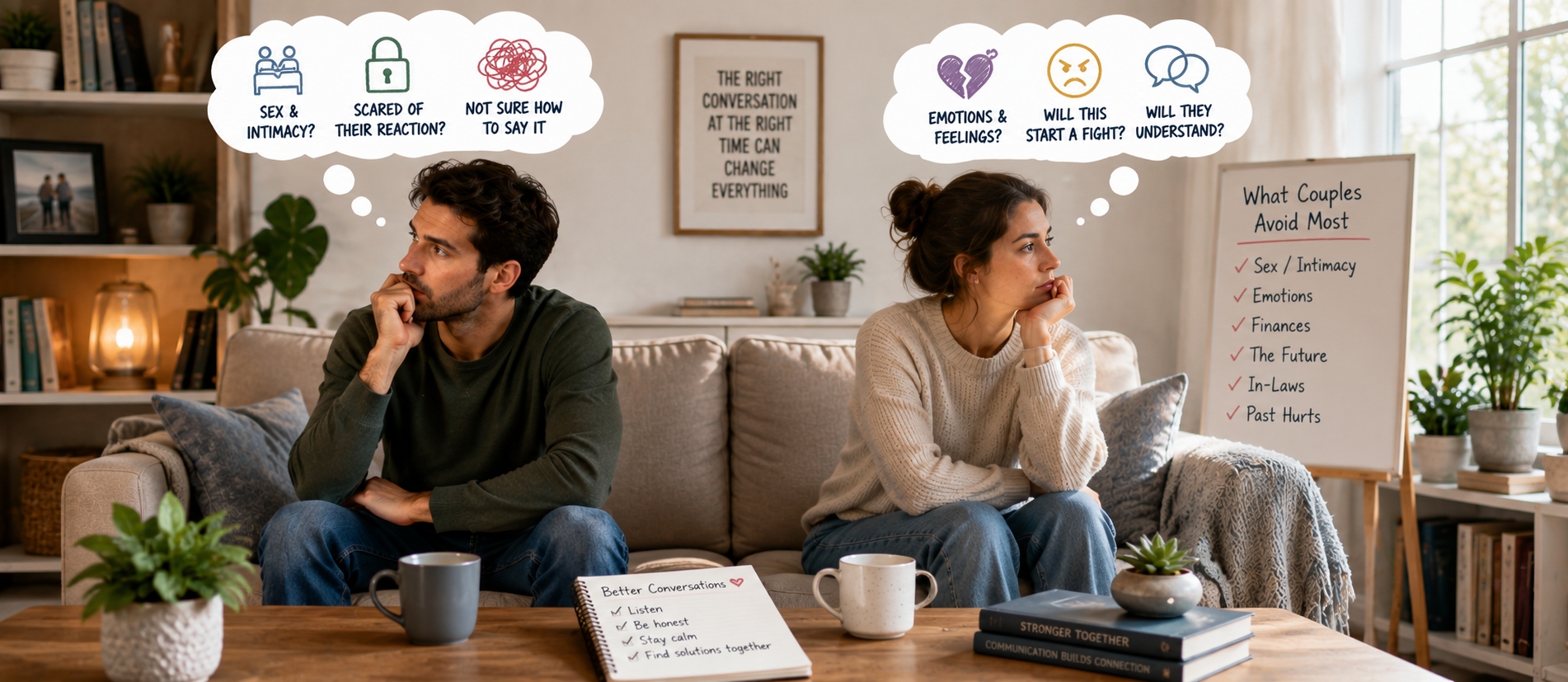
If you’ve ever wondered why you and your partner seem to avoid completely different topics, you’re not imagining it. Our survey of 2,300+ adults found real, measurable gender differences in relationship communication, though the gaps are often smaller than the stereotypes suggest.
A quick note before the data: these patterns describe average tendencies across everyone we surveyed who identified as a man or a woman, not a rule for every couple.
Many men and women fall outside these averages entirely, and this isn’t about heterosexual couples specifically.
If you’re in a same-sex or non-binary relationship, the same underlying skills apply even where these particular percentages don’t. For more on why couples go quiet in the first place, our piece on difficult conversations couples avoid covers the broader pattern beyond gender.
What the Survey Found, at a Glance
Pattern Men Women
Avoid conversations about sex or intimacy 37% 32%
Avoid conversations about emotions 33% 35%
Cite fear of their partner's reaction as a reason for staying silent 28% 31%
Report one partner shutting down during conflict 34% 38%
Report one partner usually "getting their way" 20% 19%
None of these gaps is large. Most sit within a few percentage points of each other. That in itself says something: communication avoidance is a shared, human pattern, not a man’s problem or a woman’s problem.
According to Kristen Failla, LMFT, “Although individual communication styles vary significantly among people of all gender identities, the common issues and obstacles experienced within such interactions are universal, with a united front being that communication is a concept that impacts and involves everyone.”
4 Ways Men and Women Tend to Avoid Difficult Conversations Differently
These are the four clearest gaps in our data, along with what might be underneath each one and a starting point for narrowing it.

1. Men are somewhat more likely to avoid sex and intimacy
In our survey, 37% of men avoided conversations about sex or physical intimacy, compared to 32% of women. It’s a modest gap, but a consistent one.
One possible explanation comes from research on how men are socialized around emotional expression.
The American Psychological Association has documented a pattern researchers call restrictive emotionality, where many men are raised to suppress or avoid discussing emotional experiences.
This doesn’t mean men feel less about these topics. The research above is about emotional expression broadly, not intimacy conversations specifically, but it suggests a plausible reason: less practice putting feelings into words in general could make the vulnerability that comes up around intimacy harder to navigate too.
If this sounds like your relationship, starting smaller can help. A short, low-pressure check-in about what feels good or doesn’t, separate from an actual intimate moment, tends to feel less exposing than an emotionally loaded conversation.
2. Women are slightly more likely to avoid emotional conversations, too
This one runs against a common assumption. If you searched for why women bring up emotions more, our data doesn’t fully back that up: 35% of women avoided conversations about emotions, compared to 33% of men. That’s close to even, with women marginally higher.
Our survey didn’t ask why, so we don’t want to guess at a cause that isn’t in the data. What we can say is that avoiding an emotional conversation doesn’t necessarily mean someone feels less.
It may mean they’re worried about how the conversation will land, or don’t yet have the words for what they’re feeling.
Kristen Failla highlights, “Through the study of social psychology, I have hypothesized that modern women might consciously (often as a defense or self-protective coping mechanism) be outwardly less emotional than history would suggest, potentially because they have had to be this way for so long.
A common, yet emotionally exhaustive instance of this is women being responsible for others’ emotions. This could be an example of the pendulum (of traditional gender roles and expectations) swinging over time, now allowing for people to communicate in ways that are more liberated and less restrictive.”
Either way, this pattern is a reminder not to assume your partner is the “avoidant one” just because of their gender. The data suggests both partners are about equally likely to be dodging the emotional topics.
Kristen Failla mentions, “Another example of the pendulum swinging through compensation (or overcorrecting) is noticing that traditional gender roles greatly impact and influence communication styles.
From a young age, girls are taught to be emotionally compassionate through play, while boys are taught to be competitive problem solvers. The differences we notice now within gender and emotionality can, to some degree, be related to no longer identifying with rigid roles and branching from them.”
3. Women are slightly more likely to cite fear of their partner’s reaction
Among the reasons couples gave for staying silent, 31% of women cited fear of their partner’s reaction, compared to 28% of men. Again, a modest but real gap.
This lines up with decades of research on how couples raise difficult topics.
A well-known 1990 study on marital conflict, published in the Journal of Personality and Social Psychology, found that wives were more likely than husbands to be the one raising a concern. Raising a concern more often may also mean facing the possibility of a bad reaction more often.
Later research on the same pattern found that power in the relationship, not gender itself, best predicts who ends up in the position of asking for change. Gender and power are so often entangled that a gendered pattern still shows up in the data anyway.
4. Conflict style splits along gender lines, too
In our survey, 38% of women reported that one partner shuts down during conflict, compared to 34% of men, a real if modest gap.
“One partner usually gets their way” was reported by 20% of men and 19% of women, too close to call a meaningful gender difference.
Here’s a closer look at what actually happens during a fight.
Behavior during disagreements Men Women
Old arguments got dragged in 37% 41%
Felt completely overwhelmed 29% 41%
Insults or name-calling happened 25% 31%
Behavior during disagreements Men Women
Insults or name-calling happened 25% 31%
Took a break to cool off 14% 18%
Felt their partner understood their side 15% 17%
Nothing on this list happened 20% 14%
Stayed kind or playful 7% 9%
Two of these are worth naming directly. Feeling overwhelmed shows one of the largest gaps in this breakdown, with women reporting it well over 10 percentage points more often than men.
Insults or name-calling ran the opposite direction of what a lot of people would guess: women reported this slightly more often than men, not less. If you’ve heard the assumption that men are the more verbally aggressive ones in an argument, our data doesn’t back that up.
Men were also the more likely group to report that none of these behaviors happened at all, which fits with men also reporting less overwhelm. Our survey can’t tell us whether that reflects a genuinely calmer conflict style or just a different sense of what counts as “overwhelming.”
Psychologists call a related dynamic the demand-withdraw pattern: one partner presses to discuss an issue while the other retreats into defensiveness or silence.
A 2002 review and analysis by Eldridge and Christensen found the wife-demand, husband-withdraw version of this pattern was more common than the reverse, building on the same 1990 study cited above. That original 1990 study is also where the power-over-gender nuance comes from: the pattern showed up most strongly when discussing a change the wife wanted, and weakened or reversed when the husband was the one raising the topic instead.
In practice, this means the same couple can swap roles depending on the topic. Whoever wants the change is more likely to be the one pushing, and whoever feels comfortable with things as they are is more likely to be the one going quiet.
A Few More Topics Where the Gap Shows Up
Sex, emotions, and fear of reaction are the clearest gaps in our data, but they’re not the only ones. A handful of other topics show smaller gaps worth a quick look.
Topic Men Women
Money or spending 22% 27%
Personality quirks or habits 15% 20%
In-laws or extended family 20% 24%
Work or career stress 17% 15%
None of these gaps are large enough to build a rule around, but the pattern across them is worth naming honestly. Women reported avoiding money, personality quirks, and in-laws more often than men.
Work or career stress is the one topic here where that flips, with men avoiding it slightly more. Taken as a whole, this list is a reminder that “who avoids more” depends heavily on the specific topic, not a fixed trait of either gender.
Mistakes Couples Make When They Treat These Patterns as Rules
Averages are useful for spotting a pattern, but they are easy to misuse once you know them. Here are a few ways that happens.
- Assuming your partner fits the pattern. Many men and women fall outside these averages. Treating your specific partner as a stereotype rather than a person tends to create more distance, not less.
- Using the research to score points in an argument. “Studies show men do this” is rarely persuasive to the person you’re arguing with, and can come across as dismissive rather than informative.
- Assuming the more talkative partner is the healthier one. Bringing up a topic isn’t inherently better than staying quiet about it. Both silence and constant pursuit can be ways of avoiding real vulnerability.
- Ignoring your own role in a demand-withdraw cycle. If your partner tends to withdraw, pressing harder often deepens the withdrawal instead of resolving anything.
How to Bridge the Gap as a Couple
Start by naming the pattern together, not as blame, but as a shared observation. “I’ve noticed I tend to push and you tend to go quiet, and I don’t think either of us is doing that on purpose” lands better than “you always shut down.”
If one of you tends to avoid a specific topic, like intimacy or emotions, agree on a lower-stakes way to bring it up. A written note, a walk instead of a face-to-face conversation, or a scheduled time can lower the pressure enough to make the first attempt easier.
If you recognize the demand-withdraw pattern in your own relationship, it often helps to separate the topic from the timing. The partner who wants to talk can ask when the other feels ready, rather than raising it the moment it comes to mind.
The partner who tends to withdraw can commit to a specific time to come back to it, rather than letting it drop entirely.
It also helps to know that partners often aren’t starting from the same place. In our survey, men were the group most likely to say they’d thought about making a change but hadn’t acted on it, at 26% compared to 20% of women.
Women, meanwhile, were considerably more likely to have already tried self-help resources on their own, at 31% compared to 20% of men. If you’ve been meaning to bring something up, your partner may already be ahead of you. It’s worth asking rather than assuming.
For a broader set of starting points beyond gendered patterns, our guide on how to improve communication in a relationship covers what couples in our survey actually tried and what tends to hold up.
Frequently Asked Questions
Our survey doesn't fully support this assumption either. Women were slightly more likely, not less likely, to avoid emotional conversations than men, at 35% compared to 33%. If bringing up emotional topics feels like something your partner does more than you, or vice versa, that may be specific to the dynamic between the two of you rather than a broader gender pattern. It's worth naming that directly with your partner. Asking "is this something you'd rather I brought up, or would you rather start it?" tends to open the conversation more than assuming you already know the answer based on gender. It describes a common conflict dynamic where one partner presses to discuss an issue while the other retreats into defensiveness or silence. Research on this pattern has found it more often involves wives pressing and husbands withdrawing, though later studies suggest the deciding factor is usually who wants a change made, not gender itself. Couples can and do swap roles depending on the topic at hand. If you and your partner recognize this pattern, it helps to know that neither role is inherently the problem. The pattern itself, not being stuck in one specific role, is usually what causes the most friction over time. It's common, and our survey found it happens across genders, though women reported it slightly more often than men, at 38% compared to 34%. Shutting down usually reflects feeling overwhelmed rather than not caring about the conversation or the relationship. If it happens often in your relationship, agreeing on a pause signal and a specific time to return to the conversation tends to help more than pushing through in the moment. Trying to force a conversation to continue while someone is shut down rarely produces a real resolution, and often just delays the same conversation to a worse moment later on, once frustration has had more time to build. The specific percentages in our survey reflect how the men and women we surveyed responded, and our data doesn't break results down by sexual orientation or relationship structure. The underlying skills this research points to, like naming a pattern without blame or agreeing on lower-pressure ways to raise hard topics, apply regardless of who is in the relationship. If a demand-withdraw or avoidance pattern shows up in your relationship, the practical steps in this article are worth trying whether or not the specific gender percentages match your situation. In our view, individual personality and family history matter here too, not just gender, so it's usually safer to treat each couple's dynamic as its own thing rather than a gender script. Not necessarily. The goal isn't to erase differences in communication style, but to notice patterns that aren't working and adjust them together as a couple. A couple where one partner processes out loud and the other processes internally can still communicate well, as long as both partners understand the difference and plan around it rather than expecting the other to change how they naturally think. Matching styles exactly is rarely realistic, and trying to force it often creates more frustration than it solves. Understanding and working with the mismatch, rather than eliminating it, tends to matter more for how the relationship actually feels day to day. Not according to our data. Women reported insults or name-calling happening during disagreements slightly more often than men, at 31% compared to 25%, the opposite of what many people assume. Men were more likely to report that none of a list of common conflict behaviors happened at all, which may reflect a calmer conflict style, a different sense of what counts as overwhelming, or some of both. Our survey can't tell us which explanation is correct, and we'd rather leave that open than guess. Either way, treating verbal aggression during conflict as a male trait doesn't hold up against what people in our survey actually reported experiencing, and assuming it does may say more about the stereotype than about your specific partner. Why do women bring up emotional topics more than men?
What is the demand-withdraw pattern in relationships?
Is it normal for one partner to shut down during arguments?
Does this research apply to same-sex or non-binary couples?
Should partners try to communicate in exactly the same way?
Are men more likely to yell or insult their partner during arguments?
Where This Leaves You and Your Partner
The gaps in this data are real, but they’re narrower than most stereotypes about men and women suggest. Somewhere between 3 and 6 percentage points separates most of these patterns, not a wide chasm.
What tends to matter more than which gender avoids what is whether a couple can name their specific pattern honestly and adjust it together. That’s true whether you match the averages here or not.
If a specific topic keeps getting avoided in your relationship, our survey on couples avoiding difficult conversations and our breakdown of why couples avoid difficult conversations in the first place go deeper into the reasons behind the silence.
Helpful?
Continue exploring this topic

Marriage.com AI: Your Relationship Guide
Talk through what's on your mind.
Automated
YOU COULD START WITH
Share this article on
Marriage.com Editorial Team
Relationship & Marriage Advice
The Marriage.com Editorial Team is a group of experienced relationship writers, experts, and mental health professionals. We provide practical and research-backed advice on relationships. Our content is thoroughly reviewed by experts... Read more to ensure that we offer high-quality and reliable relationship advice. Read less










 We'd love your feedback!
 Thanks for your feedback!